Showing posts with label transparency. Show all posts

10 May, 2022

Europe's Democratic Future: Falsified or Fit?


Europe's Democratic Future: Falsified or Fit?

There is a solution
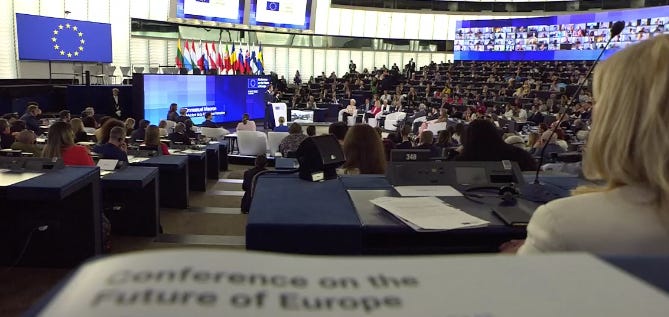
European democracy is entering its eighth decade since the Schuman Proposal of 1950. The Conference on the Future of Europe wound up in Strasbourg today. Will it help the average citizen?

What does the watchman see ahead: fog or clear waters? Where is the European ship of Democracy headed?

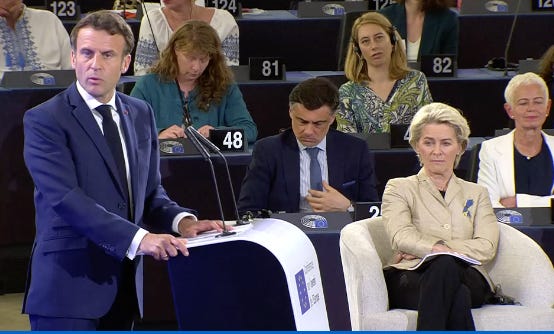
French President E Macron speaks; Commission President von der Leyen, European Parliament President Roberta Matsola and in foreground Commission Vice President Suica and Parliament’s Guy Verhofstadt listen.

Nearly four out of five Europeans want more say in decisions of the EU, according to a recent Bertelsmann Report, Under ConstructionCitizens participation in the European Union. It lists seven instruments that the politicians have designed to give an appearance of participation.

None of them are satisfactory.

  • European Parliament elections.

  • European Citizens’ Initiative

  • Petitions to the European Parliament

  • European Ombudsman

  • Public policy consultations by Commission services

  • Citizens’ Dialogues (town hall meetings)

  • European citizens’ consultation online by Council .

The Conference has produced nothing that will make a substantial difference to today’s dismal distrust of Brussels.

How to judge? The core issue is democratic control of laws, money and strategy. Adding more ‘people’s initiatives’ and ‘consultations’ won’t cut the mustard for people’s control of untrustworthy elites. They meet and decide in secret. They can ignore everybody else and invent reasons for actions that suit themselves. Secrecy is vital for tyranny. The North Koreans know this well.

Knowledge is power for leaders; that’s why politicians often enforce ignorance for the public. That’s the way tyrants keep power.

Autocrats’ desire to keep secrets may be the essential reason why the elites have refused to publish the original documents that described how Europe should really work and describe citizens’ rights to information and control. These tools would unzip modern tyranny.

Correcting this abuse is a major challenge. Schuman’s Proposal was a work of supreme genius. Who else could create peace and prosperity after 2000 years of continuous war? There are few people of his metal today.

Can Democracy work in Europe?

Is the EU doomed to failure as a democratic experiment? Not at all.

The facade of many 'dialogues' and 'initiatives' hide and cover up the real duty of leaders to follow the treaties and for honest governance. Even the treaties that politicians invented for their own benefit contain and retain principles of real and effective democracy. They just ignore the parts they don’t like.

Instead of openness, Europe has closed-door Councils ruling the roost, dishing out taxpayers' money according to their own rules. There are no published records of their debates, nor public access. Hence no accountability and no public trust.

What is the solution?

First, blow away the fog. Europeans have legal rights far beyond these inadequate, fig-leaf instruments that have little or no legal effect.

Leaders of three EU institutions pledged on 19 April 2021 to have an in-depth analysis of how the present 'democracy' differs from the original democratic framework and human rights safeguards drawn up at the start of the European Community in the 1950s. What really happened that the public is now so disdained?

Re-publication is an obvious first step to reverse the Democratic Deficit that the public have complained about for decades. Parliament is open; Council is closed.

The symptoms
Distrust is the inevitable result of politicians' disdain. The public in their Referendums rejected government by secretive councils. Each treaty with more secret bureaucracy was resisted time and time again.

Democratic fiascos followed the politicians plans for the Maastricht, Nice, the Constitutional, Reform and Lisbon treaties. Member States had referendums that rejected all these treaties. Public opinion was ignored or the public was told to reverse their vote.

What happened on the first and therefore the most important treaty? No referendum, no public debate even, was offered on renewing the foundational European Coal and Steel Treaty in 2002. It was stopped. Result? Disaster in the steel and energy economies.

And a decade later? Brexit was the inevitable result. The British referendum was actually based on a treaty the British public had never agreed to, and the French had rejected! (compare the Constitutional's Article 59 with Lisbon’s Article 50: they are practically word-for-word the same).

Conclusion: For decades the political leadership has failed the people.

Where are the goods?

The leaders failed to look at the original Schuman design for European democracy. In spite of my several complaints to the Ombudsman they failed even, as a bare minimum, to agree to publish the original constitutional documents. The Charter of the Community outlines how Human Rights should dictate fair and honest institutional development. (See https://schuman.info )

Schuman and the Founding Fathers envisaged, for example:

  1. Institutions open to the public and the press. The Lisbon treaties still repeat this requirement, see TFEU #15

  2. Consultative Committees shall be directly ELECTED to represent organised European civil society (industry, consumers, workers) and Regions. They would have revising powers to the Commission’s Proposals similar to the Council of Ministers (Schuman in Council of Europe, Aug 1950, Reuter etc).

  3. Commissioners should be unbiased arbiters and independent of political parties and lobbies etc. See their Oath in ECJ. Nor are they presently 'selected' properly and openly to public scrutiny as with the original High Authority.

  4. Parliament should be elected on the principle of one person one vote, not by the present system that gives some people 10 or 12 vote equivalents. TFEU 223.

  5. And so on.

How to start?

The same medicine is required in Brussels as in North Korea. The first step is for the public to insist that the Council of Ministers obey their own treaty. Their debates should be published. The press should be allowed to follow all aspects of the debate. The public should see it all on television and the internet. Only when ministers become accountable will a semblance of democracy begin to glimmer through the opaque panes of the Justus Lipsius building.
21 January, 2022

DANGER! European Commission refuses to publish Treaty Charter defending Citizen's Rights against technocracy!

 European Commission refuses to publish Treaty Charter on Citizen's Rights against technocracy!


Europe is in grave DANGER. 

Technocracy has OFFICIALLY replaced any veneer of Democracy and Transparency. What can the citizen do about it? 

Here are the new rules of the European Commission. They override any law or treaty, apparently.

  • Principles of democracy for the EU? Don't ask!
  • How can citizens stop irresponsible technocracy controlling their lives, imposing lockdowns, forcing inoculations and spending taxpayers' money without proper controls? Don't ask!
  • How can citizens appeal against bureaucratic abuse? Don't ask!
  • No more questions on these subjects. Journalists in the Commission Press Room are allowed to ask any question but apparently not on this subject, according to the Commission Spokesman. 
  • Just don't ask!

Why?

Censorship on bureaucratic and technocratic maladministration is the rule! That is what the Spokesperson of the European Commission declared in answer to my question.

What was my question? I asked when was the Commission going to publish the founding documents of modern Europe, Charter of the European Community. This defines how citizens can appeal against all sorts of bureaucratic abuse and malfeasance. It was signed at the time of Europe's first Community treaty in Paris on 18 April 1951.

Here is a link to my question: https://audiovisual.ec.europa.eu/en/video/I-217128

Commission Vice President Suica confirmed on 19 April 2021 that this and other historic documents on transparency and democratic control would be published for the Conference on  the Future of Europe.  That conference was initiated by French President Macron in response to the Democratic Deficit and Brexit. The conference is now drawing to a close without any discussion on the Charter.

Now apparently the bureaucrats themselves have decided that they should override both the Vice President and the public. They are refusing to publish the Charter. 

The founder of the European Community, Robert Schuman, probably had Britain's Great Charter, the Magna Carta, in mind when he called it the Charter of the Community. It is a system of justice and fair government. It defines the linkage to the human rights process.

The European Commission said that it is not going to answer the question, even if I asked it again. In fact the Spokesman refused to allow me the usual follow-up question, twice.

This is quite an extraordinary position to take. For half an hour, Mr Mamer had just answered multiple similar questions by different journalists on the bureaucratic consequences of Covid 19 on free movement of citizens. We have answered this question a thousand times, he said.  

But one answer about why the Charter is not published as promised? One answer about why bureaucrats buried it in the archives? One question as to what is going on? VERBOTEN!

And if any citizen had the naive idea that an appeal to the European Ombudsman about maladministration would have any effect on the Commission, they are mistaken. The Commission said they would ignore it!

Europe is in real danger.

After my question in the Commission Press Room, Eric Mamer, the Commission Spokesperson telephoned me. He repeated that they are not going to publish the Treaty Charter of the Community at the heart of Europe's democracy. Mr Mamer confirmed again that he would refuse to answer any further questions on the subject. 

I pointed out that the European Ombudsman had written to the Commission pointing out that the Commission had not given any reasons for not publishing the Charter. The Commission had therefore failed in its elementary duty to answer my complaint about this failure. 

Mr Mamer was adamant. He said he did not care what the Ombudsman said. Their position would not change whatever the European Ombudsman reported on the abuse. There were many other cases that they had done so. 

The letter I had received from the Commission's Secretariat General did not give any reasons for not publishing it. The official merely stated it was considered a declaration and therefore it was not going to be published, (whatever Vice President Suica said). Not logical. Surely the Commission can publish a Declaration if the Vice President said it was necessary.

The Charter is in fact an integral part of the Paris Treaty that defines the institutions of modern Europe. It defines not only the duties and installation of the Commission (High Authority), the Parliament and the Council of Ministers but also the European Court of Justice!  If you eliminate the Charter you should logically eliminate these institutions! 

This call confirms that the Commission is governed by rules of technocracy, not open democracy.

Europe is in grave DANGER.

For the Commission, apparently, it is not a question of whether the Charter is a legal and ratified part of the Paris Treaty or is a mere declaration or some other sort of document, the Spokesperson said that it is simply not going to republish it. 

I had prepared a letter to European Commission Spokesperson, Eric Mamer, following my question at today's Press conference. I then sent it to him immediately.

Here is my later letter to the EC Spokesperson in full.

Hello Eric,

In the Commission press room today, Eric, you said the Commission has answered my complaint about the non-publication of Europe’s foundational democratic documents. You did not allow my follow-up question. That did not let me clarify where you are mistaken on the Commission’s stated position for full publication. The letter (that I had not received at the time from the Secretariat General) said nothing to justify the non-publication of the Paris Treaty Charter. It merely gave an (erroneous) description of the Charter. I did not ask about the legal nature of the Charter.  That should be obvious. Schuman said that these documents provided a defence for citizens’ human rights against bureaucracy, technocracy, tyranny and totalitarianism.


The official at the Commission's Secretariat General refused to address the question of publication. The Ombudsman pointed this out to the Commission.  ‘It is not clear what relevance the nature of the document has with the decision not to publish…’ The Ombudsman added ‘The Commission has not replied to the complainant’s request that the documents should be published online and in the OJ.’


The failure to publish has nothing to do with how one official defines the document. The Commission said officially it would publish the foundational documents on European democracy.  

So did the Council. 

So did the European Parliament.


Reason enough that they should be published.  Is one official allowed to stop publication authorised by Vice President Suica and the Council Presidency? Can an official deny publication of a public document that is a constitutional foundation stone of Europe? Is a technocrat in charge to decide what is good and fit for the public to know above the Commission itself? This Charter is a document signed and sealed in Paris on 18 April1951 by the Six Foreign Ministers with plenipotentiary powers, ratified and legally deposited in the French Foreign Ministry.


The Vice President of the Commission affirmed that, for the Conference on the Future of Europe and the on-going debate on the Democratic Deficit, the Commission would publish this essential part of the Treaty of Paris. The Commission and the other institutions (EP and Council) represented in the press room on 19 April 2021 also confirmed they would publish the full text of the Schuman Declaration including what Schuman called the exordium, the initial summary that situated it in a geopolitical and historical context.


The Commission has not published either document. Fact. Why?


Is the Commission refusing to publish these documents?


I would appreciate your  reply on this question.


Regards,

David

Mr Mamer then replied to my letter as follows.

"We have spoken just now on the phone. You received a detailed letter from the Commission, dated 14 December 2021, that states the Commission’s position on the publication of the document you refer to and hence answers your questions.

As I already wrote to you on 21 December 2021, I have nothing to add to what this letter states, either in writing or in the press room. Kind regards, Eric."

 The European Commission has, inevitably, to answer to the people and to justice.


08 December, 2021

EU Document Transparency: the real Problem is Seventy years old!

Do politicians like transparency? Do cats like rain?

They prefer to stay inside, behind closed doors. 

Then they hide the papers.

The most important papers are in fact treaties that have been hidden for seventy years. 

Seventy years!

What should citizens do about it? 

Complain about missing papers? A treaty engaging governments to open government is some extraordinary piece of paper, like no other.

 "Access to Documents: what next?" That was the theme of the 15 November conference was organised on  by the European Ombudsman, Mrs Emily O'Reilly. 

The conference was told:

"The EU institutions are obliged to keep records of documents relevant to their work and any EU citizen can request to view them. This right is enshrined in EU law but Regulation 1049/2001 is now 20 years old. New technologies, as well as changing expectations about the transparency of public administrations, mean it is time to discuss the future of the EU’s access to documents rules.

Transparency and access to documents inquiries account for around one quarter of the Ombudsman’s inquiries each year. There is a fixed timetable in the procedure for requesting documents, but are there too many delays in the system? While institutions have the right to refuse access to documents for certain specific reasons, are these exemptions applied too readily?"

Seventy Years of decline

The European institutions have been around for 70 years since the Treaty of Paris was signed on 18 April 1951. That treaty had a very powerful way both to collect information about the first European Single Market. It also knew how to protect the privacy of enterprises, the trade unions and the consumers. 

Schuman was no dreamer about bureaucracies. He wrote that a badly run bureaucracy, a technocracy was the greatest danger to democracy. How do you fight an out-of-control technocracy? Transparency. He therefore built in protection of information and information sources and also provided the means to make the most important information available to the citizens.

When the United Nations wanted to organise its global information network, it called on Schuman to write a plan for them.

So why is the Democratic Deficit and maladministration such a problem today?

Blocked at Birth

Let's be clear about the origin of this problem. Let's also understand why the office of Ombudsman was invented four decades after the birth of the European Community.

The European Community was designed as an open democratic system: 

  • the Assembly was to hold open debates, 
  • the Consultative Committees and, 
  • Yes, the Council of Ministers too! 

Everything was supposed to be open to the public and the press. The principles were clearly written in the original treaties signed and sealed on 18 April 1951. 

Declaration of Interdependence

The key document was the Charter of the Community. It described how all citizens and civil organisations have the right to demand open government so that they can see, investigate and criticise each and every institution. This contrasted them with the so-called People's Democracies of the Soviet bloc. There the politburo met behind closed doors, issued its laws, stopped citizens from criticising the Party and forbade any other ideology but atheistic Communism. 

The Charter Treaty is the key document focusing on the right that will stop the EU becoming the European equivalent of the Soviet-style People's Democracy run by a politburo.

What distinguishes an autocracy from a democracy? The citizens' right to choose. With this power they can replace the so-called representatives who preferred to act as self-serving autocrats. 

The first act of the politicians was to hide or bury the Charter of the Community! This treaty was originally called the Joint Declaration of the European Community. Robert Schuman called it the Charter of the Community. It has also been called the Declaration of Inter-Dependence, reflecting the founding freedoms of the United States of America. 

The Commission has promised many times to publish this and the founding documents. It failed to deliver. Their original reluctance to publish it has led to the slippery slope of the Democratic Deficit. That has got worse and worse as one error was compounded by subsequent political compromises, not to say corruption.  

Consequences

Without the Charter and the applications of its principles, the European Commission became what Mrs Thatcher called in 1990 "an undemocratic politburo." This was just after the liberation of the Central and Eastern Europe from the Soviet Bloc. 'We are trying to get Eastern Europe to accept democratic standards and here we are recreating our own politburo,' she said. 

She was not alone, either in the UK or on the Continent.  

Generations of European democrats would not abandon the fundamental principles of impartiality and transparency. 

They made sure that it was written down -- even in the politicians' own Lisbon Treaty. Its articles say that meetings on the Council should be as open as those in the European Parliament. 

That still has not happened.

The doors of the Council of Ministers are slammed shut to the public and the press. 

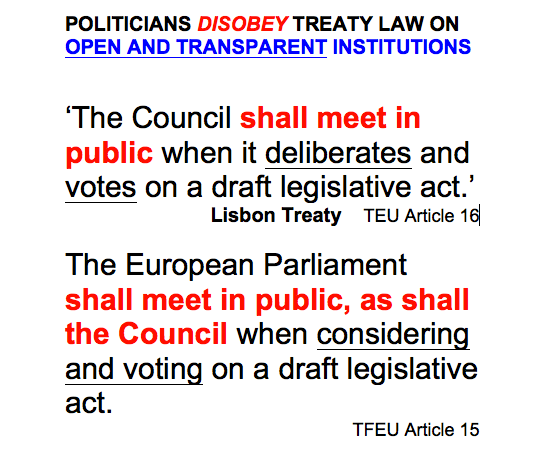
The Law says politicians have to agree to open sessions whenever they

  • consider
  • deliberate, or
  • take a common position of legislation proposed by the European Commission. 

That means practically all the time except possibly for discussions on security.

How will they be opened again? All the politicians in the Council have to agree that they should obey the treaty they signed up for.

Politicians are as difficult to herd as a clutter of cats.  But it takes only one brave, honest politician to declare and insist that the ministers have to obey the Treaty and act to open the doors.  


But even before the Lisbon Treaty, the Democratic Deficit and the closed door autocracy of the Council had stoked public frustrations, not to mention fury. What would the politicians do about it? How could they divert public opinion?

By the year 2000, the European Community system had been blatantly deformed into a politicians' cartel. People openly complained that the Commission was developing characteristics of Soviet politburo secrecy. The newly liberated countries of central and eastern Europe wanted none of that. 

So the politicians instead of applying the original treaties, decided to borrow the idea of Ombudsman from the Scandinavian countries. This would give the complainants the illusion of access. It was a veneer to cover the real problem.  It limited citizen's intrusion into their political games.  It diverted their energy into a process of fighting the bureaucracy to release documents rather than giving citizens their proper powers.

Illusion, no substance. False promises of action to publish responsibly. And far from the original basis of open democracy, full public and press access to meetings.


The excuses

What of demands for the publication of the real documents of people power from 1951? The Commission has over the years come up with a long list of excuses. 

They denied knowledge of the Charter of the Community!

Figure that out. The Commission declares that it is 'Guardian of the Treaties'. How then does the Commission not know where the treaties are?

Here is the signature page of the Charter Treaty, the Joint Declaration, signed and sealed as part of the founding Treaty of Paris.

It is signed the same day as the European Coal and Steel Treaty with its other annexes and protocols. It is signed by the same plenipotentiary ministers of Germany, France, Italy, Luxembourg, with two ministers from Belgium and the Netherlands. 

Its powers are described in the early legal literature and books on the Community, including those of Robert Schuman, Paul Reuter (who drafted much of the treaties) and others like Walter Hallstein, later president of the European Economic community. 

The Commission said they could not find it in their archives! Of course not. The last article of the ECSC treaty says the originals are kept at the French Foreign Ministry in Paris. A decade ago I wrote and obtained a copy. Why couldn't the 'Guardian of the Treaties'? 

What sort of incompetence is that?

The time for excuses is over. The governments, all organised civil society and individuals including the Ombudsman should insist that citizens have their rights recognized by the politicians.

The Charter of the Community must be published in the Official Journal!