Showing posts with label von der Leyen. Show all posts

10 May, 2022

Europe's Democratic Future: Falsified or Fit?


Europe's Democratic Future: Falsified or Fit?

There is a solution
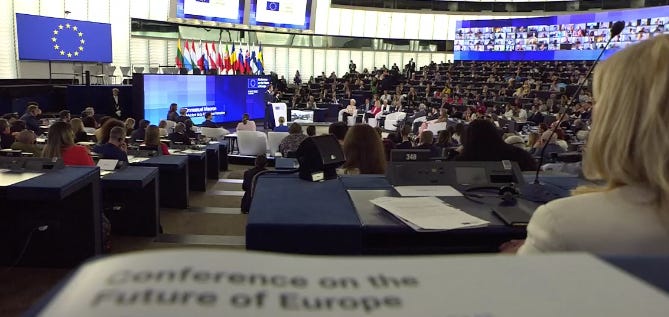
European democracy is entering its eighth decade since the Schuman Proposal of 1950. The Conference on the Future of Europe wound up in Strasbourg today. Will it help the average citizen?

What does the watchman see ahead: fog or clear waters? Where is the European ship of Democracy headed?

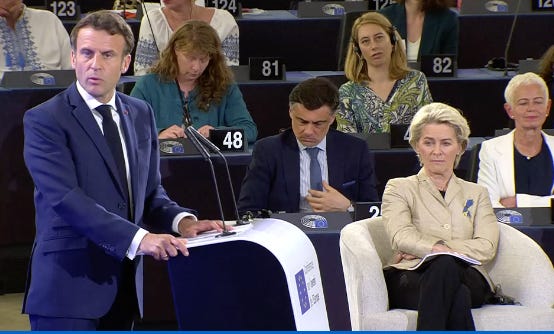
French President E Macron speaks; Commission President von der Leyen, European Parliament President Roberta Matsola and in foreground Commission Vice President Suica and Parliament’s Guy Verhofstadt listen.

Nearly four out of five Europeans want more say in decisions of the EU, according to a recent Bertelsmann Report, Under ConstructionCitizens participation in the European Union. It lists seven instruments that the politicians have designed to give an appearance of participation.

None of them are satisfactory.

  • European Parliament elections.

  • European Citizens’ Initiative

  • Petitions to the European Parliament

  • European Ombudsman

  • Public policy consultations by Commission services

  • Citizens’ Dialogues (town hall meetings)

  • European citizens’ consultation online by Council .

The Conference has produced nothing that will make a substantial difference to today’s dismal distrust of Brussels.

How to judge? The core issue is democratic control of laws, money and strategy. Adding more ‘people’s initiatives’ and ‘consultations’ won’t cut the mustard for people’s control of untrustworthy elites. They meet and decide in secret. They can ignore everybody else and invent reasons for actions that suit themselves. Secrecy is vital for tyranny. The North Koreans know this well.

Knowledge is power for leaders; that’s why politicians often enforce ignorance for the public. That’s the way tyrants keep power.

Autocrats’ desire to keep secrets may be the essential reason why the elites have refused to publish the original documents that described how Europe should really work and describe citizens’ rights to information and control. These tools would unzip modern tyranny.

Correcting this abuse is a major challenge. Schuman’s Proposal was a work of supreme genius. Who else could create peace and prosperity after 2000 years of continuous war? There are few people of his metal today.

Can Democracy work in Europe?

Is the EU doomed to failure as a democratic experiment? Not at all.

The facade of many 'dialogues' and 'initiatives' hide and cover up the real duty of leaders to follow the treaties and for honest governance. Even the treaties that politicians invented for their own benefit contain and retain principles of real and effective democracy. They just ignore the parts they don’t like.

Instead of openness, Europe has closed-door Councils ruling the roost, dishing out taxpayers' money according to their own rules. There are no published records of their debates, nor public access. Hence no accountability and no public trust.

What is the solution?

First, blow away the fog. Europeans have legal rights far beyond these inadequate, fig-leaf instruments that have little or no legal effect.

Leaders of three EU institutions pledged on 19 April 2021 to have an in-depth analysis of how the present 'democracy' differs from the original democratic framework and human rights safeguards drawn up at the start of the European Community in the 1950s. What really happened that the public is now so disdained?

Re-publication is an obvious first step to reverse the Democratic Deficit that the public have complained about for decades. Parliament is open; Council is closed.

The symptoms
Distrust is the inevitable result of politicians' disdain. The public in their Referendums rejected government by secretive councils. Each treaty with more secret bureaucracy was resisted time and time again.

Democratic fiascos followed the politicians plans for the Maastricht, Nice, the Constitutional, Reform and Lisbon treaties. Member States had referendums that rejected all these treaties. Public opinion was ignored or the public was told to reverse their vote.

What happened on the first and therefore the most important treaty? No referendum, no public debate even, was offered on renewing the foundational European Coal and Steel Treaty in 2002. It was stopped. Result? Disaster in the steel and energy economies.

And a decade later? Brexit was the inevitable result. The British referendum was actually based on a treaty the British public had never agreed to, and the French had rejected! (compare the Constitutional's Article 59 with Lisbon’s Article 50: they are practically word-for-word the same).

Conclusion: For decades the political leadership has failed the people.

Where are the goods?

The leaders failed to look at the original Schuman design for European democracy. In spite of my several complaints to the Ombudsman they failed even, as a bare minimum, to agree to publish the original constitutional documents. The Charter of the Community outlines how Human Rights should dictate fair and honest institutional development. (See https://schuman.info )

Schuman and the Founding Fathers envisaged, for example:

  1. Institutions open to the public and the press. The Lisbon treaties still repeat this requirement, see TFEU #15

  2. Consultative Committees shall be directly ELECTED to represent organised European civil society (industry, consumers, workers) and Regions. They would have revising powers to the Commission’s Proposals similar to the Council of Ministers (Schuman in Council of Europe, Aug 1950, Reuter etc).

  3. Commissioners should be unbiased arbiters and independent of political parties and lobbies etc. See their Oath in ECJ. Nor are they presently 'selected' properly and openly to public scrutiny as with the original High Authority.

  4. Parliament should be elected on the principle of one person one vote, not by the present system that gives some people 10 or 12 vote equivalents. TFEU 223.

  5. And so on.

How to start?

The same medicine is required in Brussels as in North Korea. The first step is for the public to insist that the Council of Ministers obey their own treaty. Their debates should be published. The press should be allowed to follow all aspects of the debate. The public should see it all on television and the internet. Only when ministers become accountable will a semblance of democracy begin to glimmer through the opaque panes of the Justus Lipsius building.
15 July, 2021

Reply to Commission President von der Leyen on unpublished Democracy Treaty

In recent days the European Commission has initiated major changes to the European political architecture. The EU has renounced the need for budgetary independence ('balancing the budget') and is becoming willingly subservient to international financial debt markets for the foreseeable future. It is in the process of re-engineering the entire economy on  the basis of a 'Green Deal' that has enormous implications for every man, woman and child in Europe. 


Are citizens and industries in the deal and in agreement with it? Have they ever been able to discuss this in its integrality, in-depth or in detail? Will it hinder and hamstring Europe's economy while China powers ahead with its coal-fired industries? Why are Europeans paying twice the price for energy compared with the USA? 
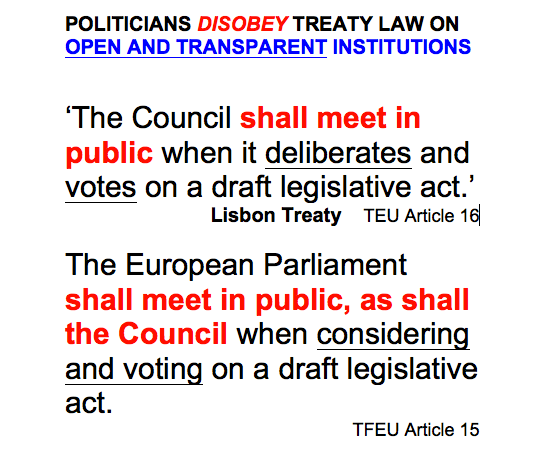
The European Commission says it is open to criticism and improvement of these gigantic plans and changes. But is it? Can the people of Europe have any influence on these and other policies? The European Council sets guidelines and plans behind closed doors. Why? The Lisbon Treaty (TFEU art 15) says the councils should be as open to the public as the Parliament. The European Commission, more and more, acts as the secretariat for an oligarchy, off-limits to observation. 
Does the EU listen to the people? Does it listen to small and medium industries? Does it respond to requests to cut spending? 
Judge for yourself!
What is the record? The European Commission has refused for seventy years to publish the treaty on how democracy should work in the European system. The principles are outlined in a treaty that its founder, Robert Schuman, called the Charter of the Community (Pour l'Europe, p146). It was signed by the Founding Fathers, plenipotentiary ministers of the six founding States at Paris on 18 April 1951. The name reflects the Magna Carta that formed the basis for democracy not only in Britain but in the United States of America and elsewhere.
If the European Commission was listening to the people it would have long published this treaty both on its website and in the Official Journal.
It has refused.
In April I wrote to President Ursula von der Leyen about this. I received a reply from an official. I enclose my reply to this and the official's letter.
Feel free to publish these letters. I appreciate your support in the cause of press freedom and proper accountability for European institutions that are supposed to be democratic.


Following is the Commission's letter and my letter to President von der Leyen 


From: David Heilbron Price <davidheilbronprice@gmail.com>
Date: Wed, Jul 14, 2021 at 9:42 PM
Subject: My letter of 9 April on the Schuman Declaration and the Charter of the Community


Your ref: Ares (2021) 2498475


                                                                Schuman Project

                                                            David Heilbron Price, Editor   


President Ursula von der Leyen

European Commission


14 July 2021

Dear Madame President,

I am in receipt of the attached letter of 1 July from Dimitri Barua (Assistant to the Director General, Communications) in reply to my letter of 9 April, for which I thank you.  Unfortunately it did not resolve or even deal with the matters I raised: the official publication of the full Schuman Declaration text (not the Proposal) and, above all, the Charter of the Community.


These documents, one a governmental Declaration at the origin of European integration and the other a Treaty, are not of mere academic interest but involve the legal basis and in fact the constitutional foundation of Europe and its future. The non-publication of these legal instruments has already led to lost opportunities for prosperity and losses of European funds amounting to millions and, in the case of Brexit, billions of euros. It is not a matter of personal ‘passionate interest’ but acknowledging the legality of documents agreed to and signed by the Founding Governments.


I was glad to see the text of the Treaty of Paris on the Coal and Steel Community has been linked to the platform of the Conference on the Future of Europe. This Treaty was long published in the Official Journal and formed the basis for actions in the European Court. 


However, the ‘Schuman Declaration’ is mislabelled. The French Government of Georges Bidault decided on a Proposal after Cabinet discussions on 3 and 9 May 1950 (Pour l’Europe, p165).  This is called the Schuman Proposal. Then later on 9 May Foreign Minister Schuman made a Declaration to the public – the Schuman Declaration. This includes his one-page introduction, declaring that the proposal marks the birth of Europe and explaining its worldwide mission of peace.


The Schuman Declaration has legal authority and should be published in the Official Journal too. It describes the profound implications of the initiative on a

·      Historical basis (It would bring peace for the first time in several millennia),

·      Geographical: (it was open to all countries including those in the Soviet sphere),

·      Economical: it would bring prosperity as never seen before,

·      Strategic: it announced the creation of Europe as a new entity in world politics,

·      Geopolitical: including its mission to Africa and other trouble spots in need of peace.


As for this unpublished first page introduction, I am quite a little puzzled why the Commission made recourse to the 'Robert Schuman Foundation'. The Robert Schuman Foundation is not a depository organisation competent to find the full text of the Schuman Declaration. It makes the same mistake as the Commission. This text can be found at the Centre Robert Schuman at http://www.centre-robert-schuman.org/robert-schuman/la-declaration-du-9-mai-1950?langue=fr and elsewhere. The full text is reproduced in facsimile in the book of the Jean Monnet Foundation, ‘Un changement d’esperance’.


Two treaties were signed by Governments on 18 April 1951 in Paris, the European Coal and Steel Community Treaty and the Charter of the Community. The originals of these documents relating to the democratic foundation of Europe can only be found at the French Foreign Ministry, as I mentioned earlier, and as the Treaty of Paris declares in its article 100.


Even more importantly, the original of the other signed treaty, the Charter of the Community (Pour l’Europe, p146) is also archived at the French Foreign Ministry. I included html copies of this major, foundational stone of European democracy that I received from the French Minister for European Affairs, Bernard Cazeneuve. It has been on my website, schuman.info , for a number of years. 


Despite my bringing it to the attention of the European Commission a number of times and underlining its importance, it has still not been published by the European Commission on its website or published in the Official Journal.


I should inform you that a complaint (number 202101229) has now been introduced with the European Ombudsman about the reluctance of the Commission to publish these key legal documents that are vital for lawyers, politicians, the press and the general public.


Madame President, the European Commission as Guardian of the Treaties should have officially published these legal documents during the last seventy years. The course of European history would have greatly benefited. For whatever reason they haven’t. But that is no reason why they should not be published now when the need is great.


I look forward to hearing from the Commission about their immediate publication.


With my thanks,


Yours sincerely,


David H  Price

Schuman Project

Schuman.info


14 April, 2021

Open Letter to President von der Leyen on Europe's Democratic Future


Open Letter to President von der Leyen on Europe’s Democratic Future


Schuman Project

schuman.info

David H Price

Editor

9 April 2021


Dear President von der Leyen,

It is 70 years since the signature on 18 April 1951 of Europe’s founding document for peace, the Treaty of Paris. This created the European Community. It changed the destiny of Europeans who had gone to war every generation for more than two thousand years.


As the European Commission and the other institutions ponder the Future of post-‘Brexit’ Europe in the Conference to be opened on 9 May, I have one request to the leaders, the media and the public.


It is necessary to recall the founding principles of that peace and prosperity. This is not hidden. It is not something that can be changed by our generation. It was written in a document, signed by the plenipotentiary representatives of the Six founding States: France, Italy, Luxembourg, the Netherlands, Belgium and Germany.


What seems shocking to me is that the European Commission and the other institutions have not published this document. Schuman, a life-long student of democracy, called this the ‘Charter of the Community’ (Pour l’Europe, p146). It describes the Community method and the democratic principles that Europe must build on, in the same way as the United States applied the same eternal laws of human nature and worldly politics.


Schuman’s use of the term ‘Charter’ reflects that of the Magna Carta as a foundational document for British democracy. It distinguishes democratic Europe from the fraudulent ‘People’s Democracies’ of the Soviet eastern bloc. It is the litmus test of true democracy.


About a decade ago I spoke to the French Minister for Europe about publishing this ‘Charter’. He kindly supplied me with a copy from the French Archives. It was published on my website, schuman.info in 2012.


Although I pointed out this remarkable and important document to the Commission President at the time, the full text of the Schuman Declaration and the Charter of the Community has still not been published on the Commission’s own website. The lack of full information about the beginnings of European democracy is a disservice both to the general public, academics, the press and political leaders.


Secondly, while the European Commission has published the ‘full text’ of the Schuman Proposal, a governmental instrument, it has not published the text of his oral Declaration. The Commission website confuses the two: the governmental Proposal is aimed at other governments. The Schuman Declaration includes the explanation of the Minister of Foreign Affairs. The Declaration includes far-reaching clarification of the original proposal agreed by the French Cabinet and signalled simultaneously to other European States via French diplomats or Schuman’s meetings with ambassadors and parliament in Paris on 9 May 1950.


It would be fitting that the foundational documents should be fully published on official websites and recorded in the Official Journal.


Madame President, I am therefore requesting that these historic texts about the Future of Europe be published before the opening of the Conference on Europe on 9 May this year.


Thanking you in advance for your attention to this matter, I remain,


Yours sincerely,


David Heilbron Price


Annexes

1.

On 18 April 1951 the great Charter of Europe, as Schuman called it, was signed by all the representatives of the six founding Member State Governments. It was then placed in the archives of the French Foreign Ministry at the Quai d’Orsay.

It is the pledge of European Governments that all European Community future Treaties founding new Community organizations, all Acts and Laws arising from them would follow certain principles. This included such things as supranational values, like honesty, justice and truth. It pledged that all citizens would have to give full democratic agreement to any developments.

After being hidden in the archives of the Quai d’Orsay for sixty years, ignored and kept secret from the public by politicians, this Foundational Declaration was released by the French Government, following a request by the Schuman Project.


Charter of the Community

Declaration of Inter-dependence Charter of the Community

Déclaration de l’Europe Paris le 18 avril 1951

CHARTE DE LA COMMUNAUTE

(Pour l’Europe, p146)

Statue Foundatrice de l’ Europe

basant sa construction sur les Principes Supranationaux et le libre choix de ses citoyens


Déclaration commune des Ministres représentant les Gouvernements signataires du Traité

Le gouvernement de la République fédérale d’Allemagne, le gouvernement belge, le gouvernement français, le gouvernement italien, le gouvernement luxembourgeois et le gouvernement des Pays-Bas :

Considérant que la paix mondiale ne peut être sauvegardée que par des efforts créateurs à la mesure des dangers qui la menacent;

Convaincus que la contribution qu’une Europe organisée et vivante peut apporter à la civilisation est indispensable au maintien de relations pacifiques;

Conscients que l’Europe ne se construira que par des réalisations concrètes créant d’abord une solidarité de fait et par l’établissement de bases communes de développement économique;

Soucieux de concourir par l’expansion de leurs productions fondamentales au relèvement du niveau de vie et au progrès des oeuvres de paix;

Résolus Ã  substituer aux rivalités séculaires une fusion de leurs intérêts essentiels, à fonder par l’instauration d’une communauté économique les premières assises d’une communauté plus large et plus profonde entre des peuples longtemps opposés par des divisions sanglantes, et à jeter les bases d’institutions capables d’orienter un destin désormais partagé,

Ont décidé de créer une Communauté européenne du charbon et de l’acier.

L’Å“uvre que nous venons de consacrer par notre signature est due à l’intelligence et à la ténacité de nos délégations et de nos experts; nous leur disons notre très grande gratitude.

Avant même d’être entrée en action, cette oeuvre a déjà, par la vertu de l’idée qui l’inspire, créé dans nos pays et au-delà de leurs frontières des espérances et une confiance tout-à-fait exceptionnelles.

En signant le traité qui institue la Communauté européenne du charbon et de l’acier, communauté de cent soixante millions d’habitants européens, les parties contractantes ont marqué leur résolution de créer la première institution supranationale et de fonder ainsi les assises réelles d’une Europe organisée.

Cette Europe est ouverte à tous les pays européens libres de leur choix. Nous espérons fermement que d’autres pays s’associeront à notre effort.

Pleinement conscients de la nécessité de donner tout son sens à ce premier pas par une action continue et du même ordre dans d’autres domaines, nous avons l’espoir et la volonté de mener à bien, dans l’esprit qui a présidé à l’élaboration de ce traité, les projets qui sont actuellement en préparation. Les travaux se poursuivront en liaison avec les organismes européens existants.

Ces initiatives, dont chacune est limitée dans son objet, devront rapidement s’inscrire dans le cadre d’une communauté politique, dont l’idée s’élabore au Conseil de l’Europe. II devra en résulter une coordination et une simplification de l’ensemble des institutions européennes.

Tous ces efforts sont guidés par la conviction croissante que les pays de l’Europe libre sont solidaires les uns des autres, participent à une destinée commune. Nous consoliderons ce sentiment en associant nos énergies et nos volontés, en harmonisant notre action par des consultations fréquentes et des contacts toujours plus confiants.

Telle est la signification de cette journée. Elle sera comprise, nous n’en doutions pas, par nos opinions publiques et par les Parlements qui seront appelés à se prononcer sur le traité. Les gouvernements ici représentés seront auprès d’eux les interprètes de notre volonté commune de construire et de servir ensemble une Europe pacifique et prospère. »


2.


Schuman Declaration – What Schuman declared


This is followed by the Schuman Proposal agreed by the French Government of Georges Bidault.

It starts “World peace cannot be safeguarded if constructive efforts are not made commensurate with the dangers that threaten it. …”

Full text at https://schuman.info/9May1950.htm


NOTE: What distinguishes Democracies — Free Choice (nations libres de leur choix)

The articulation of the ‘Free Choice’ of the Member States distinguishes them from fraudulent ‘People’s Democracies’ and dictatorships. Free societies decide their Community governance according to the most democratic procedures. A Community is created by the will of free people. It is not imposed like the constitutions of the Communist bloc by a party or parties. The Community, as manager of common resources and guardian against war between members, must be more democratic, fairer and more honest than its Member States. It should be a model of democracy for Europe and the world.

The Charter of the Community declares that all Member States

  • must safeguard the rights of their citizens before the Council of Europe according to the Convention of Human Rights and Fundamental Freedoms.
  • No national State that does not adhere to these Fundamental Rights may be admitted to ‘Europe’ whose very definition depends on this Convention of Freedom of Speech, Assembly etc
  • The voice of the nation must be respected. For example, Lisbon Treaty and its earlier redaction as the Constitutional Treaty were rejected in national referendums.
  • The free will of the people has not been given to the designation of the Commission President or the Commissioners who by law should be independent of political parties, lobbies and outside interests. The original fair system has been replaced by a closed-door horse-trading meeting of politicians.
  • Elections have not been held for the Consultative Committees (Economic and Social Committee and Committee of Regions) as assemblies of organised civil society,
  • Europe-wide election to the European Parliament (not 27 national elections) under a single statute as repeatedly included in all treaties since 1951 must be held,
  • The Court system should be fully independent of governments and outside interests.


How the Founding Fathers designed European democracy,

see https://schuman.info/supra5.htm

Why Brexit? and why do the other, oldest and strongest of Europe’s democracies like Switzerland, Iceland, Norway, not wish to join the ‘EU’? see

https://www.youtube.com/watch?v=3tcJKfuMYCk

Schuman speaks on Europe’s democratic principles for political union at the signing of the Treaty of Paris 18 April 1951.


Signatories of Europe’s founding treaty, 18 April 1951