Showing posts with label Macron. Show all posts

10 May, 2022

Europe's Democratic Future: Falsified or Fit?


Europe's Democratic Future: Falsified or Fit?

There is a solution
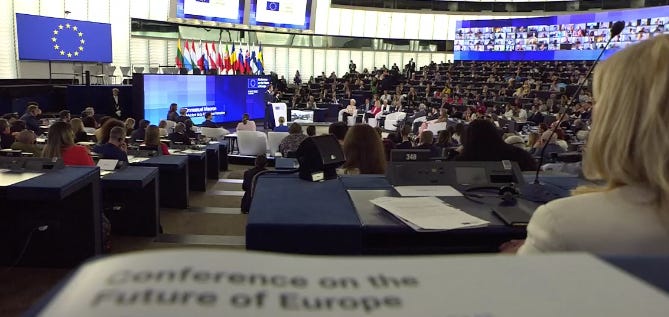
European democracy is entering its eighth decade since the Schuman Proposal of 1950. The Conference on the Future of Europe wound up in Strasbourg today. Will it help the average citizen?

What does the watchman see ahead: fog or clear waters? Where is the European ship of Democracy headed?

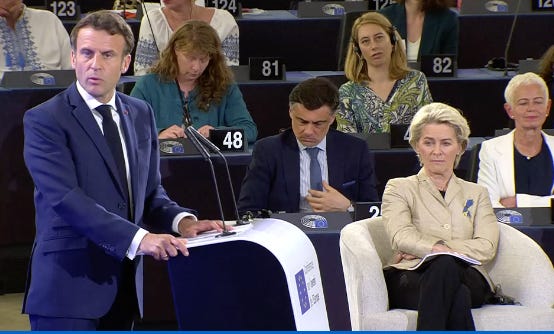
French President E Macron speaks; Commission President von der Leyen, European Parliament President Roberta Matsola and in foreground Commission Vice President Suica and Parliament’s Guy Verhofstadt listen.

Nearly four out of five Europeans want more say in decisions of the EU, according to a recent Bertelsmann Report, Under Construction, Citizens participation in the European Union. It lists seven instruments that the politicians have designed to give an appearance of participation.

None of them are satisfactory.

  • European Parliament elections.

  • European Citizens’ Initiative

  • Petitions to the European Parliament

  • European Ombudsman

  • Public policy consultations by Commission services

  • Citizens’ Dialogues (town hall meetings)

  • European citizens’ consultation online by Council .

The Conference has produced nothing that will make a substantial difference to today’s dismal distrust of Brussels.

How to judge? The core issue is democratic control of laws, money and strategy. Adding more ‘people’s initiatives’ and ‘consultations’ won’t cut the mustard for people’s control of untrustworthy elites. They meet and decide in secret. They can ignore everybody else and invent reasons for actions that suit themselves. Secrecy is vital for tyranny. The North Koreans know this well.

Knowledge is power for leaders; that’s why politicians often enforce ignorance for the public. That’s the way tyrants keep power.

Autocrats’ desire to keep secrets may be the essential reason why the elites have refused to publish the original documents that described how Europe should really work and describe citizens’ rights to information and control. These tools would unzip modern tyranny.

Correcting this abuse is a major challenge. Schuman’s Proposal was a work of supreme genius. Who else could create peace and prosperity after 2000 years of continuous war? There are few people of his metal today.

Can Democracy work in Europe?

Is the EU doomed to failure as a democratic experiment? Not at all.

The facade of many 'dialogues' and 'initiatives' hide and cover up the real duty of leaders to follow the treaties and for honest governance. Even the treaties that politicians invented for their own benefit contain and retain principles of real and effective democracy. They just ignore the parts they don’t like.

Instead of openness, Europe has closed-door Councils ruling the roost, dishing out taxpayers' money according to their own rules. There are no published records of their debates, nor public access. Hence no accountability and no public trust.

What is the solution?

First, blow away the fog. Europeans have legal rights far beyond these inadequate, fig-leaf instruments that have little or no legal effect.

Leaders of three EU institutions pledged on 19 April 2021 to have an in-depth analysis of how the present 'democracy' differs from the original democratic framework and human rights safeguards drawn up at the start of the European Community in the 1950s. What really happened that the public is now so disdained?

Re-publication is an obvious first step to reverse the Democratic Deficit that the public have complained about for decades. Parliament is open; Council is closed.

The symptoms
Distrust is the inevitable result of politicians' disdain. The public in their Referendums rejected government by secretive councils. Each treaty with more secret bureaucracy was resisted time and time again.

Democratic fiascos followed the politicians plans for the Maastricht, Nice, the Constitutional, Reform and Lisbon treaties. Member States had referendums that rejected all these treaties. Public opinion was ignored or the public was told to reverse their vote.

What happened on the first and therefore the most important treaty? No referendum, no public debate even, was offered on renewing the foundational European Coal and Steel Treaty in 2002. It was stopped. Result? Disaster in the steel and energy economies.

And a decade later? Brexit was the inevitable result. The British referendum was actually based on a treaty the British public had never agreed to, and the French had rejected! (compare the Constitutional's Article 59 with Lisbon’s Article 50: they are practically word-for-word the same).

Conclusion: For decades the political leadership has failed the people.

Where are the goods?

The leaders failed to look at the original Schuman design for European democracy. In spite of my several complaints to the Ombudsman they failed even, as a bare minimum, to agree to publish the original constitutional documents. The Charter of the Community outlines how Human Rights should dictate fair and honest institutional development. (See https://schuman.info )

Schuman and the Founding Fathers envisaged, for example:

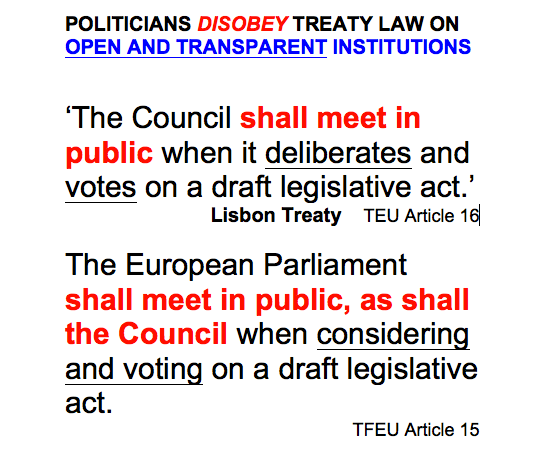
  1. Institutions open to the public and the press. The Lisbon treaties still repeat this requirement, see TFEU #15

  2. Consultative Committees shall be directly ELECTED to represent organised European civil society (industry, consumers, workers) and Regions. They would have revising powers to the Commission’s Proposals similar to the Council of Ministers (Schuman in Council of Europe, Aug 1950, Reuter etc).

  3. Commissioners should be unbiased arbiters and independent of political parties and lobbies etc. See their Oath in ECJ. Nor are they presently 'selected' properly and openly to public scrutiny as with the original High Authority.

  4. Parliament should be elected on the principle of one person one vote, not by the present system that gives some people 10 or 12 vote equivalents. TFEU 223.

  5. And so on.

How to start?

The same medicine is required in Brussels as in North Korea. The first step is for the public to insist that the Council of Ministers obey their own treaty. Their debates should be published. The press should be allowed to follow all aspects of the debate. The public should see it all on television and the internet. Only when ministers become accountable will a semblance of democracy begin to glimmer through the opaque panes of the Justus Lipsius building.
21 January, 2022

DANGER! European Commission refuses to publish Treaty Charter defending Citizen's Rights against technocracy!

 European Commission refuses to publish Treaty Charter on Citizen's Rights against technocracy!


Europe is in grave DANGER. 

Technocracy has OFFICIALLY replaced any veneer of Democracy and Transparency. What can the citizen do about it? 

Here are the new rules of the European Commission. They override any law or treaty, apparently.

  • Principles of democracy for the EU? Don't ask!
  • How can citizens stop irresponsible technocracy controlling their lives, imposing lockdowns, forcing inoculations and spending taxpayers' money without proper controls? Don't ask!
  • How can citizens appeal against bureaucratic abuse? Don't ask!
  • No more questions on these subjects. Journalists in the Commission Press Room are allowed to ask any question but apparently not on this subject, according to the Commission Spokesman. 
  • Just don't ask!

Why?

Censorship on bureaucratic and technocratic maladministration is the rule! That is what the Spokesperson of the European Commission declared in answer to my question.

What was my question? I asked when was the Commission going to publish the founding documents of modern Europe, Charter of the European Community. This defines how citizens can appeal against all sorts of bureaucratic abuse and malfeasance. It was signed at the time of Europe's first Community treaty in Paris on 18 April 1951.

Here is a link to my question: https://audiovisual.ec.europa.eu/en/video/I-217128

Commission Vice President Suica confirmed on 19 April 2021 that this and other historic documents on transparency and democratic control would be published for the Conference on  the Future of Europe.  That conference was initiated by French President Macron in response to the Democratic Deficit and Brexit. The conference is now drawing to a close without any discussion on the Charter.

Now apparently the bureaucrats themselves have decided that they should override both the Vice President and the public. They are refusing to publish the Charter. 

The founder of the European Community, Robert Schuman, probably had Britain's Great Charter, the Magna Carta, in mind when he called it the Charter of the Community. It is a system of justice and fair government. It defines the linkage to the human rights process.

The European Commission said that it is not going to answer the question, even if I asked it again. In fact the Spokesman refused to allow me the usual follow-up question, twice.

This is quite an extraordinary position to take. For half an hour, Mr Mamer had just answered multiple similar questions by different journalists on the bureaucratic consequences of Covid 19 on free movement of citizens. We have answered this question a thousand times, he said.  

But one answer about why the Charter is not published as promised? One answer about why bureaucrats buried it in the archives? One question as to what is going on? VERBOTEN!

And if any citizen had the naive idea that an appeal to the European Ombudsman about maladministration would have any effect on the Commission, they are mistaken. The Commission said they would ignore it!

Europe is in real danger.

After my question in the Commission Press Room, Eric Mamer, the Commission Spokesperson telephoned me. He repeated that they are not going to publish the Treaty Charter of the Community at the heart of Europe's democracy. Mr Mamer confirmed again that he would refuse to answer any further questions on the subject. 

I pointed out that the European Ombudsman had written to the Commission pointing out that the Commission had not given any reasons for not publishing the Charter. The Commission had therefore failed in its elementary duty to answer my complaint about this failure. 

Mr Mamer was adamant. He said he did not care what the Ombudsman said. Their position would not change whatever the European Ombudsman reported on the abuse. There were many other cases that they had done so. 

The letter I had received from the Commission's Secretariat General did not give any reasons for not publishing it. The official merely stated it was considered a declaration and therefore it was not going to be published, (whatever Vice President Suica said). Not logical. Surely the Commission can publish a Declaration if the Vice President said it was necessary.

The Charter is in fact an integral part of the Paris Treaty that defines the institutions of modern Europe. It defines not only the duties and installation of the Commission (High Authority), the Parliament and the Council of Ministers but also the European Court of Justice!  If you eliminate the Charter you should logically eliminate these institutions! 

This call confirms that the Commission is governed by rules of technocracy, not open democracy.

Europe is in grave DANGER.

For the Commission, apparently, it is not a question of whether the Charter is a legal and ratified part of the Paris Treaty or is a mere declaration or some other sort of document, the Spokesperson said that it is simply not going to republish it. 

I had prepared a letter to European Commission Spokesperson, Eric Mamer, following my question at today's Press conference. I then sent it to him immediately.

Here is my later letter to the EC Spokesperson in full.

Hello Eric,

In the Commission press room today, Eric, you said the Commission has answered my complaint about the non-publication of Europe’s foundational democratic documents. You did not allow my follow-up question. That did not let me clarify where you are mistaken on the Commission’s stated position for full publication. The letter (that I had not received at the time from the Secretariat General) said nothing to justify the non-publication of the Paris Treaty Charter. It merely gave an (erroneous) description of the Charter. I did not ask about the legal nature of the Charter.  That should be obvious. Schuman said that these documents provided a defence for citizens’ human rights against bureaucracy, technocracy, tyranny and totalitarianism.


The official at the Commission's Secretariat General refused to address the question of publication. The Ombudsman pointed this out to the Commission.  ‘It is not clear what relevance the nature of the document has with the decision not to publish…’ The Ombudsman added ‘The Commission has not replied to the complainant’s request that the documents should be published online and in the OJ.’


The failure to publish has nothing to do with how one official defines the document. The Commission said officially it would publish the foundational documents on European democracy.  

So did the Council. 

So did the European Parliament.


Reason enough that they should be published.  Is one official allowed to stop publication authorised by Vice President Suica and the Council Presidency? Can an official deny publication of a public document that is a constitutional foundation stone of Europe? Is a technocrat in charge to decide what is good and fit for the public to know above the Commission itself? This Charter is a document signed and sealed in Paris on 18 April1951 by the Six Foreign Ministers with plenipotentiary powers, ratified and legally deposited in the French Foreign Ministry.


The Vice President of the Commission affirmed that, for the Conference on the Future of Europe and the on-going debate on the Democratic Deficit, the Commission would publish this essential part of the Treaty of Paris. The Commission and the other institutions (EP and Council) represented in the press room on 19 April 2021 also confirmed they would publish the full text of the Schuman Declaration including what Schuman called the exordium, the initial summary that situated it in a geopolitical and historical context.


The Commission has not published either document. Fact. Why?


Is the Commission refusing to publish these documents?


I would appreciate your  reply on this question.


Regards,

David

Mr Mamer then replied to my letter as follows.

"We have spoken just now on the phone. You received a detailed letter from the Commission, dated 14 December 2021, that states the Commission’s position on the publication of the document you refer to and hence answers your questions.

As I already wrote to you on 21 December 2021, I have nothing to add to what this letter states, either in writing or in the press room. Kind regards, Eric."

 The European Commission has, inevitably, to answer to the people and to justice.


20 February, 2020

EU continues its CAP scam that UK failed to reform

'UNACCEPTABLE!'
That's what David Sassoli, president of the European Parliament called the draft €1 Trillion budget for 2021-27, prepared by the Commission and the European Council. He was addressing a press conference at the European Council meeting of 20 February.
Why was it unacceptable? He earlier told the Council meeting that 'No one wants to burden our fellow citizens with new taxes.'
Was he defending the taxpayer against this extravagance? No. He wants more money, more taxes for spending on European projects.
Cutting the money on the Common Agricultural Policy (CAP) leaves citizens ‘undefended‘, he said. ‘The Parliament is vigilant,‘ he added. ‘We will defend the citizens of Europe. We will make sure that the Union’s programmes are financed in a way that is adequate for that purpose.‘
So what is adequate? How much money should be designated for agriculture?
The same message came from French President Emmanuel Macron. The European Council was called to deal with the European budget, 2021-2027, he said. The first priority that he mentioned as he entered the European Council building was the CAP.
'The CAP has allowed us to provide food for Europeans since the 1960s,' he said. 'It is a great success for France and Europe.'
Then he revealed that there were plans to increase the budget to give realisation to further plans.
Let’s stop at Agriculture, seeing this is the priority topic. The drafts of the budget from the Commission and the Council all foresee more than 30 per cent of the budget going on agriculture. Parliament would like to see an even bigger budget in general.
So how much does the Agriculture sector represent in the total economy of the EU? Thirty percent? Nowhere near! Not even close to twenty percent or even ten.
Agriculture represents a smidgen above ONE percent of the economy. European agriculture is efficient. It does not employ many people. So why does it need so much of the European tax-payers’ money? What about Technology and jobs for the future? What is the reaction of European tax-payers? Is it discussed inside the luxurious chamber where the heads of government meet?
The truth is we do not know. The sessions are secret. Doors are closed and governments divide the tax money according to how they wish to influence their most important people — their voters or rather their bosses.
Since the 1960s France has led the other States by the nose. It was the big nose of General de Gaulle. He decided to sabotage the democratic system of Robert Schuman. 
De Gaulle decided that the majority of the European Communities‘ budget should be spent on agriculture. His voters were men of the soil and it was the way he could show he was a patriot– getting the Germans to pay for French cheeses.

Money would go to the big landowners. Up till recently the list of who got the CAP money was SECRET! Is something smelling foul? -- and it's not cheese!
Far from a success story, the CAP really got out of hand. In 1985 70 per cent of the European budget was spent on agriculture. Brussels used the budget to keep buying French and other farm products as if there was no tomorrow. That is when all the agricultural products built up into huge unmanageable stockpiles and lakes. There were beef mountains, wine lakes, milk lakes. These meat products were shoved into more and more fridges, wine of all sorts was converted into alcohol or other products and milk into powder. All the alternative uses for these products was sought until Europeans were bloated and distended.
Europe was stuffed to the gunnels with farm products — all thanks to the CAP. Export markets were full too. So the Brussels people sold off what they could at knock down prices to the Soviet Union — the enemy of the Cold War! So the poor citizens paid high prices for their food while at the same time subsidising the Communist take-over of Europe!
The CAP was a corruption bomb that the UK was unable to defuse. When UK joined the European Communities in 1973, the British agricultural system was supported on an entirely different system, deficiency payments. UK did not have enough land to sustain its people entirely for their food needs. During the world war, Britons tried to grow as much as possible. Afterwards, the UK relied on the Commonwealth for imports, whether grain from Canada or lamb and butter from New Zealand. These countries were far more efficient than the Continent.


Couve de Murville receives instructions from President de Gaulle

The sly Gaullist Foreign Minister, Maurice Couve de Murville, told Britain during the negotiations that they would have to change their buying habits and buy from the Continent. He did not have to say that that meant France above all. Everyone knew it.
So the origins of the CAP are not exactly built on the best deal for the people. CAP meant more expensive food. it also meant votes for the Gaullists.
The British vowed that they would stop this crazy scheme before it got out of hand. The amount of the Community budget spent on the CAP reached SEVENTY PER CENT in 1985 before it started to decline a little. France and Italy and some other countries had choice land and had some of the most corrupt practices including wine made out of chemicals and olive plantations with no olive trees.
The British had within easy reach a possible success story for reforming the out-of-control CAP. It was the Treaty of Rome itself. All they had to do was to get the other ministers to follow the treaty articles that specify that the CAP must be under democratic control.

UK failed. Hence Brexit. 
The European Economic Community treaty signed in Rome in 1957 has a whole chapter on the Agricultural Community. It calls for full democratic control in a common organisation — an agricultural committee under the Economic and Social Committee — to supervise prices and supplies for the benefit of three categories:
  • farmers,
  • workers and
  • consumers.
They were never implemented! Consumers have never had a voice! But they paid for the corrupt practice and high prices!
Thus the European Council is celebrating behind closed doors one of the greatest international fraud machines of all time. They are also celebrating the exit of their greatest, but in the end ineffectual, critic, the United Kingdom.
And today on 20 February 2020 they are preparing for seven more years of the same scam in the Multiannual Budget 2021-2027.