Showing posts with label Future of Europe. Show all posts

21 January, 2022

DANGER! European Commission refuses to publish Treaty Charter defending Citizen's Rights against technocracy!

 European Commission refuses to publish Treaty Charter on Citizen's Rights against technocracy!


Europe is in grave DANGER. 

Technocracy has OFFICIALLY replaced any veneer of Democracy and Transparency. What can the citizen do about it? 

Here are the new rules of the European Commission. They override any law or treaty, apparently.

  • Principles of democracy for the EU? Don't ask!
  • How can citizens stop irresponsible technocracy controlling their lives, imposing lockdowns, forcing inoculations and spending taxpayers' money without proper controls? Don't ask!
  • How can citizens appeal against bureaucratic abuse? Don't ask!
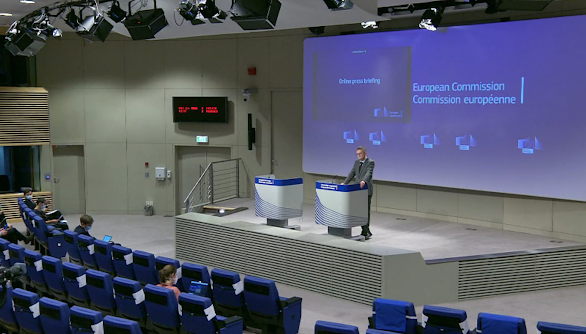
  • No more questions on these subjects. Journalists in the Commission Press Room are allowed to ask any question but apparently not on this subject, according to the Commission Spokesman. 
  • Just don't ask!

Why?

Censorship on bureaucratic and technocratic maladministration is the rule! That is what the Spokesperson of the European Commission declared in answer to my question.

What was my question? I asked when was the Commission going to publish the founding documents of modern Europe, Charter of the European Community. This defines how citizens can appeal against all sorts of bureaucratic abuse and malfeasance. It was signed at the time of Europe's first Community treaty in Paris on 18 April 1951.

Here is a link to my question: https://audiovisual.ec.europa.eu/en/video/I-217128

Commission Vice President Suica confirmed on 19 April 2021 that this and other historic documents on transparency and democratic control would be published for the Conference on  the Future of Europe.  That conference was initiated by French President Macron in response to the Democratic Deficit and Brexit. The conference is now drawing to a close without any discussion on the Charter.

Now apparently the bureaucrats themselves have decided that they should override both the Vice President and the public. They are refusing to publish the Charter. 

The founder of the European Community, Robert Schuman, probably had Britain's Great Charter, the Magna Carta, in mind when he called it the Charter of the Community. It is a system of justice and fair government. It defines the linkage to the human rights process.

The European Commission said that it is not going to answer the question, even if I asked it again. In fact the Spokesman refused to allow me the usual follow-up question, twice.

This is quite an extraordinary position to take. For half an hour, Mr Mamer had just answered multiple similar questions by different journalists on the bureaucratic consequences of Covid 19 on free movement of citizens. We have answered this question a thousand times, he said.  

But one answer about why the Charter is not published as promised? One answer about why bureaucrats buried it in the archives? One question as to what is going on? VERBOTEN!

And if any citizen had the naive idea that an appeal to the European Ombudsman about maladministration would have any effect on the Commission, they are mistaken. The Commission said they would ignore it!

Europe is in real danger.

After my question in the Commission Press Room, Eric Mamer, the Commission Spokesperson telephoned me. He repeated that they are not going to publish the Treaty Charter of the Community at the heart of Europe's democracy. Mr Mamer confirmed again that he would refuse to answer any further questions on the subject. 

I pointed out that the European Ombudsman had written to the Commission pointing out that the Commission had not given any reasons for not publishing the Charter. The Commission had therefore failed in its elementary duty to answer my complaint about this failure. 

Mr Mamer was adamant. He said he did not care what the Ombudsman said. Their position would not change whatever the European Ombudsman reported on the abuse. There were many other cases that they had done so. 

The letter I had received from the Commission's Secretariat General did not give any reasons for not publishing it. The official merely stated it was considered a declaration and therefore it was not going to be published, (whatever Vice President Suica said). Not logical. Surely the Commission can publish a Declaration if the Vice President said it was necessary.

The Charter is in fact an integral part of the Paris Treaty that defines the institutions of modern Europe. It defines not only the duties and installation of the Commission (High Authority), the Parliament and the Council of Ministers but also the European Court of Justice!  If you eliminate the Charter you should logically eliminate these institutions! 

This call confirms that the Commission is governed by rules of technocracy, not open democracy.

Europe is in grave DANGER.

For the Commission, apparently, it is not a question of whether the Charter is a legal and ratified part of the Paris Treaty or is a mere declaration or some other sort of document, the Spokesperson said that it is simply not going to republish it. 

I had prepared a letter to European Commission Spokesperson, Eric Mamer, following my question at today's Press conference. I then sent it to him immediately.

Here is my later letter to the EC Spokesperson in full.

Hello Eric,

In the Commission press room today, Eric, you said the Commission has answered my complaint about the non-publication of Europe’s foundational democratic documents. You did not allow my follow-up question. That did not let me clarify where you are mistaken on the Commission’s stated position for full publication. The letter (that I had not received at the time from the Secretariat General) said nothing to justify the non-publication of the Paris Treaty Charter. It merely gave an (erroneous) description of the Charter. I did not ask about the legal nature of the Charter.  That should be obvious. Schuman said that these documents provided a defence for citizens’ human rights against bureaucracy, technocracy, tyranny and totalitarianism.


The official at the Commission's Secretariat General refused to address the question of publication. The Ombudsman pointed this out to the Commission.  ‘It is not clear what relevance the nature of the document has with the decision not to publish…’ The Ombudsman added ‘The Commission has not replied to the complainant’s request that the documents should be published online and in the OJ.’


The failure to publish has nothing to do with how one official defines the document. The Commission said officially it would publish the foundational documents on European democracy.  

So did the Council. 

So did the European Parliament.


Reason enough that they should be published.  Is one official allowed to stop publication authorised by Vice President Suica and the Council Presidency? Can an official deny publication of a public document that is a constitutional foundation stone of Europe? Is a technocrat in charge to decide what is good and fit for the public to know above the Commission itself? This Charter is a document signed and sealed in Paris on 18 April1951 by the Six Foreign Ministers with plenipotentiary powers, ratified and legally deposited in the French Foreign Ministry.


The Vice President of the Commission affirmed that, for the Conference on the Future of Europe and the on-going debate on the Democratic Deficit, the Commission would publish this essential part of the Treaty of Paris. The Commission and the other institutions (EP and Council) represented in the press room on 19 April 2021 also confirmed they would publish the full text of the Schuman Declaration including what Schuman called the exordium, the initial summary that situated it in a geopolitical and historical context.


The Commission has not published either document. Fact. Why?


Is the Commission refusing to publish these documents?


I would appreciate your  reply on this question.


Regards,

David

Mr Mamer then replied to my letter as follows.

"We have spoken just now on the phone. You received a detailed letter from the Commission, dated 14 December 2021, that states the Commission’s position on the publication of the document you refer to and hence answers your questions.

As I already wrote to you on 21 December 2021, I have nothing to add to what this letter states, either in writing or in the press room. Kind regards, Eric."

 The European Commission has, inevitably, to answer to the people and to justice.


01 March, 2017

EU's White Paper on Europe's Future fails Basic Democratic Test

Democracy? What Democracy?
EC White Paper Future of Europe x
The day before the European Commission’s launch of a White Paper on the Future of Europe, the European Commission was asked directly about Democracy. Its main responsibility is enhancing democratic accountability in Europe. Robert Schuman, the founder of modern Europe, defined democracy in a way that makes it the best definition yet. He defined European Democracy on 18 April 1951 with the Great Charter of Europe and the first Economic Community Treaty, the treaty of Paris.
The Commission failed the democratic test.
It also fails its elementary history test as it thinks Europe was born with the Treaty of Rome in 1957. The 60th anniversary of Europe occurred in 2011, as I wrote in an Open Letter to the then Commission President Barroso.
Enhancing democratic accountability‘ was promised in the Five President’s Report, 2015 on Deepening Economic and Monetary Union. The Brussels leaders had already taken unprecedented powers, overturning referendums against the Constitutional Treaty (and renaming this corpse the Lisbon Treaty). They overturned other referendums, as in Greece and told old-established democracies to vote again in their referendums because the No vote was unacceptable. They parachuted a former Commissioner to become a Prime Minister in Italy. They replaced another country’s by a banker.
Enhancing democratic accountability? Some would say ‘Nothing but PR chaff‘. But what is the opinion of the Commission? It avoids the issue.
The Brussels leadership does not seem to get it. Europeans have lost trust in Brussels. For them Brussels Democracy is heading for the cliff.
The White Paper gives options, but no democratic option. Democracy is not about setting different options that government politicians choose. It is not about governments choosing. It is about people choosing. And first of all the people must choose who their leaders are.
It says we, the Politburo, are in power. All that is needed is for you to choose whether we will do a lot of things you do not like or just a few.
Here’s the test. If the Brussels Politburo is really democratic it will point to the record it has achieved in improving democracy. If it is a bunch of autocrats, they will not.
What are the great achievements can the EU claim in two years?
The Chief Spokesman was asked:
“Two years ago the Commission adopted the Five Presidents’ Report. This said that in the first stage of {deepening Economic and Monetary Union} there would be “enhancing European democratic accountability.” Since then we have had the rise of what one might call anti-Brussels parties or “popularist” parties as some people might call them. And we had the Mother of Parliaments, the United Kingdom, rejecting what “democracy” is in Brussels.
Can you give us some positive developments that have happened that have enhanced democratic accountability?”

 EC Margritis Schinas x
He was unable to come up with any positive measures. “I don’t see the centre of gravity of the question,” the Spokesman said, adding unconvincingly that “if you want me to reiterate that Europe is about democracy, then yes, I am happy to say so.”
The reality is quite different. Brussels is under siege by anti-Brussels political parties, not only in the UK but in nearly all the Member States. They object both nationally at the attitudes of governmental “main-stream” parties and Europe-wide at Brussels closed-door autocracy.
Worse.
Brexit Front Cover 8
When the UK, the Mother of Parliaments, is so fed up with Brussels autocracy that a nation-wide referendum gave notice to quit the “European Union”, the Brussels clique, its Politburo, only seems to rejoice. Within hours of the vote result being announced, four presidents (Commission, Council, Parliament and European Council) issued a statement.
It said: “We now expect the United Kingdom government to give effect to this decision of the British people as soon as possible, however painful that process may be. Any delay would unnecessarily prolong uncertainty. We have rules to deal with this in an orderly way.
The Brussels Politburo failed to take the situation seriously. The core of the problems is Brussels itself. The politicians there do not follow even the most elementary articles of the treaties, never mind “enhancing them”.
While avoiding to catch my eye for the usual immediate follow-up question, the Spokesman eventually relented at the end of the press conference.
Question: “The White paper will talk about options. One option that is in all the treaties is that there should be a Europe-wide election for the European Parliament. Is this going to be in the White Paper?”
Answer:
“The election for the European Parliament does not have to be in the White Paper because it is a reality since 1979.”
Not true. The present system of 28 national elections to Parliament is fraudulent on several accounts. The actual treaty article 136 of EEC or 108 of Euratom said:
“The Assembly shall draw up proposals for elections by direct suffrage in accordance with a uniform procedure in all Member States.”
The politicians had refused any sort of elections up to 1979. Some parties like the British Labour party boycotted the European Parliament because it was not elected but was chosen by party chiefs without the voice of the people. When the politicians were forced by the Courts to have elections, they did so with great reluctance … and a pair of scissors.
They cut out the end of the sentence about a uniform procedure. They agreed to one election for each State under quite different rules for each set by the government parties.
Thus the Assembly/Parliament moved from Cronyism Mark One to Cronyism Mark Two.
Anyone who knows what the treaties say — and we hope the Commission’s Spokespersons’ Group are aware of the most basic principles — should know that elections ought legally to be:
  • under a single Statute, not 28 national Statutes,
  • for the whole European Union, not 28 separate territories,
  • and for all the European citizens not just those with national IDs to be counted separately,
  • that a voter should have ONE vote not up to the equivalent of a dozen, as happens now.
The original democratic principles of the European Community system includes:
  • elections to the European Parliament,
  • elections to the Consultative Committees that control European laws affecting the economic, social and regional life of citizens. These are the bodies the Founding Fathers saw as being instrumental to manage the European Currency and also various aspects of the economy including Migration.
  • the means to refuse potential members of the Commission, who are not of sufficient sterling character and impartiality. All candidates should be refused if they they are obviously biased or partisan (members of interest groups, political parties, national representatives). They should be refused if they are without sufficient character or experience to withstand the influence of lobbies, whether national or global.
  • all meetings of the Councils that discuss, debate or decide such laws should be open to the public and press.
Until the Commission publishes a White Paper on legal and proper elections to the European institutions, Brussels will continue to be classified as an autocratic Politburo system, not a democracy.

31 October, 2012

Supra1: Supranational values create the 'Grand Bargain' of Europe, not party oligarchs or markets.

The former British Prime Minister Tony Blair has called for a ‘Grand Bargain’ to set Europe on the right track. Part of his idea, said Mr Blair, speaking in Berlin at the Council for the Future of Europe on 29 October 2012, is the election of the President of the European Commission.
‘My feeling is that the only way, ultimately, confidence can be restored is with a fully comprehensive set of measures that convince markets and public alike that the fundamental issues have been overcome.’
The first major mistake of this analysis relates to the true foundation of European construction. It is a supranational institution.
  • It is not based on pleasing the markets.
  • Europe cannot be built on money like the euro (even if it were well-constructed and it isn’t).
  • Nor can it be built on commercial activity (even if the EU is the largest commercial power in the world, equivalent to the USA, Canada and India).
  • It cannot even be built on some ideological concept of democracy. (Ideology means part truth).
Putting the Commission into the hands of politicians by elections, organized and controlled by political parties, is completely wrong. It would exclude 98 percent of the population who are not members of political parties. It is the road to disaster. It violates the most elementary principles of Human Rights. A fairer, more just and honest idea is required.

Europe must be founded on truth and the search for truth. Truth can be arrived at by experience, examining one’s conscience and investigation. That is the only realistic basis for a sound society. Experience tells us that politicians should not be given absolute control, that their  declarations should be examined by ordinary citizens and interest groups in non-political representative bodies. Their conclusions should be published and examined conscientiously by all the public.

That is because all human beings have a tendency to corrupt and putting known corrupters in charge of anti-corruption is to corrupt the system absolutely.

Appeasing corruption is no formula for resolving the present crisis, nor for the future. AT THE MOMENT POLITICIANS ARE FAR TOO KEEN TO OBSCURE CORRUPTION RATHER THAN EXPOSE IT AND CORRECT IT.

European integration can only be founded on values like fairness, justice and honesty. Schuman called these supranational values because, in the past, empires, federations and confederations have collapsed because of violation of justice and the rule of law. Science properly founded on correct premises is a supranational value, said Schuman. Its results were true in antiquity (even if not always recognized). It is true today. As Schuman learned in his university days, justice decided in the court systems of ancient societies tended to follow similar rules to modern justice. Societies also failed when, as contemporary critics observed, corruption replaced justice or when sexual depravity became commonplace. Today lack of trust in politicians does not justify giving them more powers.

It is true that Europe needs to defend itself externally from predatory and dangerous powers that would like to exploit its disunity. That idea is not new. Schuman said that precisely in his address to the United Nations General Assembly in 1948: ‘Europe must unite to survive.’ Europeans have fought each other for thousands of years and disunity is more natural than unity.

What is important for us now is how the foundation based on supranational values can be developed. These values form the basis for European democracies. They arose from Christian basis of our civilization but also present in other successful societies too.
Should Europeans fear the future? Should they chase after the chimera of exploitative wealth?
Mr Blair says: ‘The 21st Century case for Europe is based not on war or peace but on power or irrelevance. A 21st Century with China and India that in time, as GDP and population size realign, will become vast economic and political powers.’
Where this analysis is wrong is that ALL civilizations will fail if they cannot handle the problem of corruption. This is true not only for China, India and Europe but also for Russia and other rising, populous states including the super-rich but corrupt oil powers of the Middle East. What is relevant is building on a sound foundation, not coveting immoral and unethical practices that seem to bring instant wealth. Peace, which Europe gained by the Community, can continue to bring vast improvement in technical and moral progress, when the real keys of the supranational system are  honestly applied.

Where Mr Blair makes a further fundamental mistake is to ignore the fact that a Grand Bargain has already been made. It is the politicians too often who are responsible for not holding to it. Take for instance the European Commission. Mr Blair says it should be elected. That sounds fair. But it is not what the Grand Bargain of 18 April 1951 to put an end to war made actually says.  Electing the President would throw the whole procedure into the hands of the political parties who have a near monopoly of putting up candidates. It would reinforce the party political control of the institutions. Within the main political parties a small group of party officials decides on who should be candidate. Thus the whole process puts the presidency of the Commission into the hands of party machines and a few apparatchiks who decide.

This is an oligarchic system and has great dangers. It does not oppose antidemocratic attitudes of fellow politicians. The European Council would reinforce its undemocratic meetings of all and everything in secret. The ultra-secret Eurozone group would cook up lawless schemes to bilk the public of trillions of euros. No democratic control is possible. The Commission becomes fully complicit in any corruption. The independence of the Commission from governments, and from political parties and from any commercial, industrial or other interest group, is fundamental to the Community system.

The word ‘supranational’ appears twice in Europe’s founding treaty and in subsequent treaties like the European Political Community and Defence Community.

This proposal of Mr Blair is directly opposite to what the original Grand Bargain entailed. So what was the Grand Bargain of 18 April 1951?  It provided a way to end war between Member States. It created FIVE mutually independent institutions to safeguard this bargain and to build the future. By separately analyzing and then cross-checking the proposal of an impartial Commission (alone able to propose legislation), the most democratically fair bargain could be struck to provide the basis for European laws, taxes and budgets.

1. The European Commission must be (a) INDEPENDENT and (b) represent Europe not national interests or in fact not be tied to any interest group at all. The Commission must be impartial. Therefore the selection of the future Commissioners must be made by a process that would avoid political corruption or the election of those representing special interests.

2. The Commission should be in permanent dialogue with a consultative body representing Organized Civil Society. These Consultative Committees should be elected equally from three lists of European professional organizations representing workers, consumers and entrepreneurs. There should also be elections for the Committee of Regions and the Euratom Committees. These Consultative Committees have full powers in the preparation and supervision of all European legislation.

3. The Council of Ministers should be held in OPEN sessions. There should be no taxation without full and appropriate debate both inside the Council and also in the national parliaments.

4. The European Parliament should be elected according to a single statute for all the territory of the European Union. There should no longer be 27 national elections where the government parties bias the rules in favour of their own political parties. (Under the Lisbon Treaty the Parliament gave up its prime weapon for democracy — the ability to sack the Commission.)

5. The Court of Justice should be composed of impartial judges who are open to all tribunals and courts for their ruling on the interpretation of European law.

The most solemn part of the Great Bargain of 18 April 1951 was that no European measure should be brought in WITHOUT THE WHOLE-HEARTED AGREEMENT OF THE EUROPEAN PEOPLES. It is called the Great Charter of Europe, its Declaration of Interdependence.

This is not what has happened in Europe recently where we have seen treaties brought in by secretive cabals of politicians, meeting in the dead of night in European Councils. These treaties are not OPEN nor are they agreed freely by the people. They are as legitimate as the measures brought in by the Politburos of the so-called ‘People’s Democracies’ of the Soviet era. Worse, the politicians went ahead even though, in the few referendums that the politicians permitted, the public of several nations pronounced decisively against them. Then the politicians changed the system so that no further referendums would be permitted, especially in the founder States who knew exactly what abuses had been committed by de Gaulle and others!

The Great Charter said that the Community was the TRUE FOUNDATION of an organized Europe. It was declared as the first instance of a supranational organization in the world. It was a Community of peoples (not political groups). It set as prime condition that the people must be ‘FREE TO CHOOSE’. The first measure of renewing the Grand Bargain is to republish this Great Charter. It is the first Statute of European Law.
Mr Blair said: ‘I bear the scars of participation in the Amsterdam Treaty, the Nice Treaty, the – Laeken process culminating in the Lisbon Treaty and the 2005 EU budget negotiation, when the UK held the Presidency –  the most difficult negotiation I participated in, (even including the Northern Ireland peace agreement.) Many of those here today bear similar scars!
The politicians are likely to get many more scars until they learn their lessons about the real foundations of European democracy.