The original concept of supranational democracy for Europe brought long-lasting peace to the Continent. EU's founder Robert Schuman described democracy as being in the service of the people and acting in agreement with the people. What's going on today? See also www.schuman.info and http://democracy.blogactiv.eu .
Showing posts with label Coal and Steel Community. Show all posts
Showing posts with label Coal and Steel Community. Show all posts
To House of Commons and House of Lords Brexit Committees
Questions to be put to Attorney General Geoffrey Cox.
Please circulate to all committee members:
Serious flaws in the legal procedure for the Brexit Article 50 letter have been pointed out to Parliament in two enclosed Petitions. Action, and legal and constitutional clarification is urgently required. Six copies of the book “Brexit and Britain’s Vision for Europe“, sent to Brexit Secretaries of State and Brexit Committees, deal with the issues in full.
The petitions raise three issues, vital for the prosperous future of the UK and good relations with our European partners.
1. Euratom. No ballot paper was issued, nor prior notification given, nor publication made, nor Government statement in Parliament about leaving Euratom before the vote of 23 June 2016. Nuclear security, energy and medicines should not be compromised by a flawed Brexit concept defying and overstepping any legal authority of the people in the referendum. No assent was given. Whatever HMG thinks, or opinion Parliament later passes, Euratom is a distinct and separate international treaty for 28 Member States in a Community system.
2. European Union only, not EEC. The ballot paper was about leaving “the European Union” not the European Communities. The 1975 Referendum gave a two-thirds majority in favour of staying in the European Community.
The European Union was defined in the subsequent treaties as additions to the European Economic Community, EEC. This included new institutions and bureaucracies. Many times referendums were promised. None materialised. Major changes were introduced against the popular sentiment, especially in the Lisbon Treaty, almost identical with the undemocratic and rejected Constitutional Treaty.
The Euratom and European Coal and Steel Communities were not subsumed in the EU.
Leaving the European Union means leaving EU treaties that have not been ratified by the people in the 1975 referendum. It does not mean leaving the EEC Customs Union, Single Market or nuclear safeguards of Euratom.
3. Referendum required for Treaty validation. The articles modifying the EEC to make it the EU Treaty were rejected in referendums in France, the Netherlands, Ireland. The exact words of article 50 were rejected by referendums when it was called the Constitutional Treaty. They would almost certainly have been rejected in UK had the referendum been carried out at any time before 2016. It was promised by both Labour and Conservatives. They stated such a referendum was necessary to validate it. HMG cannot use referendum article 50 in the unvalidated EU Treaty. It is an abuse and a breach of duty. It is both unsafe and dishonest.
First, a review is needed. Article 50 needs to be paused. The treaty needs ratification by referendum to validate it. So said both governments. HMG is now trying to use this flawed operation to override the non-exit clauses validated by the 1975 referendum. It is unsafe to do so. Both the EEC and Euratom have articles stating that the treaties are “concluded for an unlimited time” (article 240 EEC, 208 Euratom). Why? Because all States and peoples agreed that Open Democracy was the only way for the future of Europe to solve problems. HMG cannot override the people’s voice and due constitutional process without dire consequences.
Petition on Euratom
Petition Article 50 treaty Flaw
UK’s and Europe’s future and prosperity depends on tackling its common responsibilities for the Democratic Deficit. Europe’s history shows that in 1950 its two millennia of wars and killing can be changed into unprecedented peace. This new challenging phase needs to be tackled with the same determination for honesty and good will to all.
Many thanks for your urgent attention to this. I look forward to hear your response.
David Price
Editor, Schuman Project eurDemocracy
This
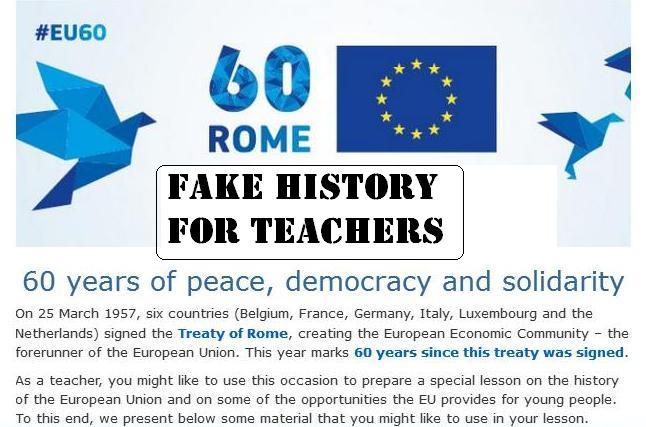
year 2017 will go down in history as the year European leaders
conspired in Fake News, Fake History and Fake Geography! With their
slogan EU60 they will be ridiculed by future generations as fraudsters
using Fake Maths too. Why do they lie about dates? FAKE DEMOCRACY!
The Brussels leaders say this year is Europe’s 60th Birthday. That’s clearly untrue. In 2012 the Nobel Prize was awarded to the European Community/ EU for more than SIXTY years contribution to peace in Europe! Count it! Do some elementary arithmetic!
With the headline J’ACCUSE, Emile Zola wrote an open letter to
President Faure of the French Republic covering the front page of the
newspaper L’Aurore, 13 January 1898. It caused a sensation. It was meant to.
In this article Zola denounced the lies and establishment cover-up of
the French government in the Dreyfus affair. The French army officer,
who happened to be a Jew, was falsely accused to being the source of
espionage for Germany and Austria-Hungary. The writing in the dossier
sheet was used as evidence that the Germans had received French secrets.
It had been fished out of a waste bin in the German embassy by a French
cleaning lady. The handwriting was nothing like that of Dreyfus. That
did not deter the experts. They asserted that “the lack of resemblance between Dreyfus’ writing and that of the bordereau (dossier cover list) was proof of a ‘self-forgery'”!
It was obviously a Fake but the Fake experts said it was so good a
Fake, it must mean that Dreyfus was guilty! In truth it was the experts
who were fake and the Establishment who were traitors! Note how Fakers
use Fake logic! The entire world whose writing did not resemble the
bordereau writing would be guilty by that reasoning! Only one person
wrote that bordereau.
The bordereau writing actually matched a major who was working in the
French General Military Staff. The guilty man had the suspicious
Austro-Hungarian name of Esterhazy. But that made no difference for the
anti-Semitic establishment who wanted to put on an anti-Jewish show
trial.
Zola exposed the unpalatable truth. He named names in the high-level
cover-up by the military staff and French Government. Result? He was
accused of libel and had to flee to England!
But he was proved right. Two men were innocent, Zola and especially
Dreyfus. They suffered most. Today there is no doubt about who is
guilty. The truth always comes out.
The victim was all of Europe. The entire French military had to be
cleaned up. It had dire consequences. France was left in a weakened
state when it faced the Germans in World War One. High-level fraud is not uncommon. That is the lesson that the present European leaders need to learn. Their guilt will affect all of Europe. Nor will the truth of history redound to their glory.
During the whole of 2017, European leaders have connived in
propaganda fraud. They have spent millions of tax-payers money to hide
Europe’s real democratic history. Fraud hurts! Sometimes it costs lives, many lives. Take
Stalin. Did the USSR survive his Fraud and Fakes? Photographs of the
Stalinist regime in the USSR became notorious. The Politburo of the
early days was republished from time to time. Each time the one or two
of the original faces disappeared and the photo was made up as if they
never existed. They were either in a Gulag camp or dead allegedly for
treason. Stalin cost millions of other lives.
Today the European Union Politburo is interested in wiping out one face in particular, Robert Schuman. This is done not because that face is guilty of anything. Quite the reverse.
He is responsible for the miraculous rise of Europe as a super-power
in the world today. The keys to war and peace in Europe — and elsewhere —
are the greatest heritage of modern times. Why are the Brussels
Politburo throwing those keys away? Personal aggrandizement? Ignorance?
Petty jealousy? or what Schuman called the routines of power,
the inability of politicians and bureaucracies to think in other terms
than Europeans had for more than a thousand years?
The Brussels Politburo are especially keen to wipe out the signing of
the Treaty of Paris on 18 April 1951 and the Great Charter of Rights of
European Citizens (DECLARATION COMMUNE) that was also signed that day.
That showed how West European States can demonstrate they are real
democracies and expose the false democracies as they existed in East
Germany and elsewhere behind the Iron Curtain.
The guilty neo-Gaullist Brussels Poltiburo wanted none of this. While
the public expected the founding Paris treaty to be renewed in 2002, the
Council Politburo failed to do so -- without any public debate, never
mind any referendums.
Today
the guilty are more attached to money and markets than democracy and
openness. They want to say that Europe’s miraculous rise came from its
common market. They want people to believe their future depends on
globalization. False! The guilty try to cover-up their foul deeds and
those of earlier betrayers of the past. Who are the guilty today? EU
photos and histories today only show the guilty. These are the people
in Rome who celebrated Europe’s fake history by saying Europe began 60
years ago with the 1957 Treaty of Rome and the European Common Market.
The same goes for their propaganda. Their histories mainly start when
Schuman was no longer active or alive.
Why?
Why do they date EU history from Rome in 1957 and the signing of the
treaties of Rome? Why chose an event where Robert Schuman, the Father of
Europe, was absent? Could it be that that was the year the
anti-democratic Charles de Gaulle seized power in France?
That certainly is true. Today’s leaders in France and Germany want to
celebrate the Franco-German axis as if it was the start of Europe. That
is utterly false history. De Gaulle wanted to rule and dominate Germany
and all the other countries such as Italy and the Benelux.
Let’s see if there is any resemblance of EU60 to the truth.
Schuman’s Proposal saved Europe from catastrophic wars. The EEC Customs Union didn’t.
The ECSC created Europe’s first Single Markets in 1953. Rome didn’t.
We could add a few other achievements like being co-author of the
1949 NATO treaty and initiating the Council of Europe, 1949 with its
Convention of Human Rights and Fundamental Freedoms, 1950.
Writing Fake History is like trying to make Dreyfus’s handwriting look like Esterhazy’s. Let’s add some other facts.
De Gaulle attacked Schuman. He tried to destroy the Community system.
De Gaulle invented the Franco-German axis as the motor of Europe because he could then control Germany.
De Gaulle turned the EEC into a milch cow so that up to 70 percent
of taxpayers money was spent on the CAP and farmers, usually French
peasants.
De Gaulle would not attend Schuman’s funeral and stopped Adenauer, who had already agreed, from attending.
De Gaulle had nothing to do with European Reconciliation. Adenauer
wrote that Schuman achieved this in 1950. De Gaulle wanted to expand
French borders to the Rhine!
De Gaulle was an autocrat. He hated political parties.
De Gaulle refused to have elections to the
European Parliament and persuaded Adenauer to stop these elections too.
Because of de Gaulle, Europeans have never had a proper election to the
European Parliament.
We could also add: De Gaulle kicked the Supreme European Headquarters
of NATO out of Paris. French forces left NATO. He despised and ignored
the Council of Europe and to gain power, was instrumental in the bloody
Algerian war and fierce torture. De Gaulle couldn’t destroy the European
Communities, no matter how hard he tried. The best damage he could do
was to “chloroform”
it for a while. He made sure the democracies of UK, Norway, Denmark and
Ireland did not join. He vetoed the applications three times — without
asking any advice of his ministers or asking parliament. He preferred
Franco’s fascist Spain.
Why is Brussels celebrating 1957? De Gaulle took power in 1957!
Politicians admire his style, exploiting the Common Market budget for
his own purposes. De Gaulle pillaged European taxes for his own
distorted version of the Common Agricultural Policy.
It took European money to bribe French voters to keep him in power.
Cunning! They would like to do the same. He made sure the Council had
doors closed to the public so criticism was muted. Weaker Europeans
could be exploited for Gaullist strong-arm policy. Democratic opposition
was gagged. That’s why politicians still keep the doors closed today.
It’s contrary to the Lisbon treaties that they like. Article 15 TFEU
says the Council shall meet in public! Why is the press so passive?
Decades to pro-Gaullist dog-training!
Many other politicians today like the idea of doing what they like
behind closed doors with the people’s money. Maybe that’s why in 2013
the Council celebrated de Gaulle as if he was a hero of Europe, not its arrogant opponent.
Why don’t honest politicians object to this abuse? It takes both guts, honesty and education. One prime minister told a Davos meeting
that the treaty that brought peace in Europe was the Treaty of Rome!
Frankly this prime minister, who claimed to be a historian, was either
(a) ignorant (b) deceived by EU propaganda or (c) a deceiver.
He wasn’t alone on the stage that day. The Commission first vice president agreed. He comes into the same category. He said: ‘No more paternalism. That was Schuman etc. Very paternalistic people.’
Wrong!
In fact it was de Gaulle who was paternalistic and autocratic. He
bossed everyone around, including the Dutch. Schuman created the first
stage of Europe’s democratic system, the opposite of paternalistic. Was
Mr Timmermans making a slip of the tongue? That’s why I later asked him,
in the presence of Europe’s religious leaders: “Do
you think this year’s emphasis on EU60 on the market has been overblown
compared with the 1951 beginning of Europe with the Treaty of Paris and
reconciliation, and a discussion about European democracy?”
Commission Vice-President Timmermans replied: “May I remind you
that the EU started with defence and not internal market or currency. It
started with an attempt at defence which was defeated in the French
Parliament.”
The facts? In August 1954, after other Member States had ratified it,
the French National Assembly voted to suspend the vote on the European
Defence Community, CED. What about the Schuman Declaration of 1950 or
the Treaty of Paris of April 1951 — which legally defined what the
Commission was supposed to do?
Not sure whether this was another slip of the tongue, the next week I
posed the same question to the Commission Spokesman. I asked whether
the Commission, as supposed guardian of the original treaties, now
refused to recognize that the European democratic project had begun with
the Schuman Declaration of 9 May 1950 and Europe’s first treaty, the
Treaty of Paris signed on 18 April 1951.
The Commission spokesman refused to make any correction to this
monumental error about the origin of the EU, the European Community,
democracy and the Commission itself.
Lies upon lies and fraud upon fraud! How did this self-deception happen?
From the first, the Community Method and true European step-by-step,
consensual democracy was attacked by politicians who wanted to create a
pseudo-federal system. Others like the Gaullists just wanted to
dominate the other States.
The Community is a system that has potential for the common and open search for truth and common interest for the present and the future.
Instead of open democracy of the treaties, politicians preferred the
Gaullist distortion of secretive power in the Council and Commission.
Instead of the Community sectoral system (coal, steel, atomic
energy, customs) that each required full democratic consent, politicians
wanted to control all sectors of the European economy.
Instead of an impartial, Jury-like Commission that excluded
politicians brandishing party cards, the politicians wanted to exclude
non-partisan, impartial citizens such as experienced diplomats,
engineers, scientists, academics, trade unionists, inventors from
becoming members of the Commission.
Schuman and the Founding Fathers realized that the European system
cannot be placed in the hands of politicians alone. It must be open to
impartial citizens of high moral character, exercising their God-given
rights to freedom. Why? Because, as Schuman knew and said, politicians
have the tendency not only not to resist the corruption of power but to
obscure its very existence. They tend to follow party over public
interest, individual interest over collective interest.
That is why two institutions should be politician-free by definition: the European Court of Justice and the European Commission, Europe’s Jury.
The third, the Consultative Committees, is instructed to act as
impartial representatives of European civil society. That is it should
involve professional associations of all sorts, with democratic
mandates. The consultative committees, such as the as-yet, non-elected
Committee of Regions and the tripartite Economic and Social Committee,
(workers, consumers and entrepreneurs’ associations) act as honest witnesses to the state of Europe and the requirements of Europe’s future.
How did politicians and governments set Europe on its downward path? Arrogance. All
human beings have a tendency to corrupt. Putting known corrupters in
charge of anti-corruption is likely to corrupt the system more rapidly.
Their path to infamy? Maastricht, Amsterdam,
Nice and the failed Constitutional treaties illustrate their process of
political and psychological disorder. Is it a coincidence that the
initials spell out MANiC?
Europe’s most severe problem of legitimacy arose with the Lisbon
Treaty. It extended both their unlawful and unauthorized grasp for
power. It reiterated their denial of Referendum NOs. “And Lisbon” turns
their acronym to MANIACAL. The Constitutional Treaty was roundly rejected in referendums. it was
hugely unpopular especially in those countries that did not get to vote
in a referendum.
This was a big disappointment for the prime ministers (plus the
French President!). They wanted to have enhanced limelight. The European
Council, known earlier as the European Summit of Heads of State and
Government, was invented by de Gaulle in 1961. Its goal, to seduce
European leaders with fancy food and allow de Gaulle to be Master of
Europe! Today European leaders want to act like little Napoleons with
helicopters and snazzy limousines to take them to discussions on global
warming!
No sweat for thieves of democracy! They mobilized their plush
phantom democracy, the Council of Ministers. That and the European
Council (which was not then any form of European legislative
institution, nor a real Intergovernmental Committee recognized by
treaty) foisted Fake Democracy on the European people by FRAUD and
FORCE.
How?
Europe’s Founding Fathers had good, democratic reasons not to create a
European Council. It would try to centralize power in secret. When the
Constitutional Treaty was rejected, top politicians worried that they
may have lost this further lever of central power. The European Council,
under the Nice Treaty, could not then even publish a press release. It
had no executive power. Its sole responsibility was to meet twice a year
and (as the Summit conference for heads of State and government) and
submit a report after these two meetings to the European Parliament and a
yearly report on progress.
The Community system is built on sectoral responsibilities. This is
why the sectoral Councils of Ministers are one of the legal instruments
for the European peoples’ legislation. Legislation Proposals by an
impartial European Commission are to be transmitted to three
institutions only: Council of Ministers (Industry, Fisheries,
Agriculture, Science etc), the Parliament and the Consultative
Committees. These institutions have to send their amendments if they
find faults. Then the Commission decides on the most impartial
formulation which it publishes in the Official Journal as Law. That’s how Europe should work. Simply, openly and democratically.
The European Council or the Summit is not involved in this. It cannot dictate.
How did the politicians get round this problem in 2007? They got the
Council of Ministers to publish the Press Release or Decree of the
European Council. It still had no legal force. Who did they publish it
to? Not the public but the national delegations!
The Council press release to the Delegations announced two
conspiratorial measures: Money and political Might. The politicians
would spend a great deal of European tax-payers’ money on propaganda and
press management. Secondly their political might would FORCE the
articles of the failed Constitutional Treaty through the parliaments.
They would use their national party-controlled majorities against
virulent protest and righteous objections of the public. They did not
call this a Conspiracy against the people. They called it
“Consultations” with fellow politicians!
Thus a small clique of politicians could act totally against the
people’s referendum NOs. To oil their way they would need money.
This logo became the official symbol for the “50th anniversary” events during 2007.
Even today it is surprising to read the brazenness of this political
ploy. In the same paragraph that showed the strategy to override the
referendums, the press release said that money would be necessary for PR
enforcement. For that sleight of hand, the European Council proposed
that finance be poured into a fraudulent 50th Birthday for Europe, the
Treaty of Rome. (Not the European Atomic Energy Treaty, Euratom, mind you, only in practice the European Common Market, the EEC!).
This is what the Council Press Release said about the Constitutional
Treaty that lay dead in the water after the French vote of 29 May 2005
and the Dutch vote of 1 June 2005.
Council press release 22 February 2007 “Pursuing reform: the Constitutional Treaty.
As agreed by the European Council at its meeting of June 2006, the
Union has followed a two-track approach. It has focused on making best
use of the possibilities offered by the existing treaties to deliver
concrete results while preparing the ground for continuing the reform
process. The presidency (of the Council of Ministers) provided
the European Council with an assessment of the consultation with Member
States regarding the Constitutional Treaty. The outcome of these
consultations will be passed to the German Presidency as part of its
preparation for the report to be presented during the first half of
2007. The European Council reaffirms the importance of commemorating the
50th anniversary of the treaties of Rome in order to confirm the
importance of the European integration process.”
The chosen path was to avoid any more referendums at all costs. The second decision was to act as if the No
referendum results had never happened! Thirdly the rejected treaty
would be broken into individual amendments. They would be reassembled
and added to articles that could modify the EEC, Treaty of Rome and make
it exactly like the Constitutional Treaty. Huzzah! Hokus Pokus! The Constitutional Treaty lives again in spite of the people!
Thus the politicians made sure their two dozen votes were more
important than millions of voters in referendums nixing the
Constitutional Treaty. They could make a dead treaty live again, even if
the public had stuck a dagger in its heart!
They ordered the civil servants to prepare a book of amendments
modifying the Nice treaty (itself a modification of the Amsterdam
treaty, itself a modification of the Maastricht treaty, itself a
modification of the European Economy Community treaty of Rome.) For the
record, not all Member States were ‘allowed’ by politicians to hold
referendums on these earlier treaties.
None of these treaties were really legal. The Maastricht treaty had
been rejected by the Danes. The Nice treaty was rejected by the Irish.
The Constitutional Treaty was rejected by both the French and the Dutch.
UK had no referendums on any. Then, when the civil servants had
finished their dirty work, the Irish rejected the Lisbon Treaty.
Other countries had no chance to have a referendum. Why? The Irish
European Commissioner, Charlie MacCreevy, said 95 percent of the
European governments would lose a referendum vote on the Lisbon Treaty.
The Economist called him “Teller of painful truths.”
The original treaty of Rome , EEC, had a clause which basically said,
this treaty does not permit Member States to leave, because all member
States agree that the only sure solution for peace and prosperity is to
make Europe more democratic. Only a foolish government, if it claimed to
be a democracy, would want to leave. That Article 224 of the EEC treaty
had become Article 312 of the Nice Treaty.
It was yanked out and replaced by an exit article in the
Constitutional Treaty. Referendums in France and the Netherlands
rejected this Article 59
and all the Constitutional Treaty. It then became Article 50 of the
Lisbon Treaty. The British had no chance to reject either Article 59 of
the Constitutional Treaty or Article 50 of the Lisbon Treaty. The
various UK political parties that in election manifestos promised
referendums on European treaties betrayed their promises when in power.
They told the public: “No referendum! We know best!”
Why are the British finding it so difficult to leave the EU? Actually
it is not too difficult. The European Union was the illegal
superstructure added to the European Economic Community. Most of its
MANiC changes reduce democracy, or try to. They empower politicians
against the people.
The Community system is, however, a different matter. The British in
the 1975 referendum agreed to the Community method with an overwhelming
majority of 67 percent. It was seen as democratic, and a means to
improve the democratic climate of Europe.
The Community method requires one European election (not 28 national
ones) to the European Parliament. That is still in the treaties.
It requires elections to the Consultative Committees. (That is also still in the treaties.)
It requires card-carrying politicians to be banned from the European Commission. (That is still in the treaties.)
It requires the Council of Ministers to be open to the public, just
like the parliament, when they ‘consider, discuss and vote’ on any draft
legislation. (That is still in the treaties.)
Schuman designed the Community system during the war, when he escaped
from Nazi Germany as a prisoner. He told his friends during the war
that the future European system would enable postwar Germany to
reinforce its democratic tendencies. It would also reduce their
proclivity to autocracy as they had experienced under Hitler and others.
He compared it to chaining European States together, so that they
would be obliged by their own self-interest to become more democratic.
Following the scandals of the Gaullist era with its wine lake, and beef
mountains, its corruption in high places and its election bribery,
Brussels has succumbed to some pretty low politics.
But it has not failed to deliver positive benefits to its citizens.
The European Community won’t go away. It won’t fail to continue. Today it is not Germany who wants to leave the European institutions.
It is the island that says it has the Mother of Parliaments. Why?
Britons smell something rotten wafting over the Channel from Brussels.
Today the Manifest Crisis of democracy
is apparent both sides of the Channel and in east, west, central and
southern Europe. The solution is simple. Follow the instructions in the
original treaties.
Have elections as required under a single Statute to the European Parliament.
Ban active politicians from the Commission.
Open up the Council of Ministers to the public and the press.
Make the Judges in the Court of Justice democratically responsible.
Hold elections of properly constituted European professional
associations to the Consultative Committees. Stop lobbyists altogether.
Replace the secretive COREPER and thousands of closed ‘expert’
committees with elected expert members of these democratic
organizations.
The outcome of Brexit would be the same as if Germany wished to
leave. Schuman said the new favorable climate the Community created
would make it totally unpalatable for any country to leave. In this contest, my bet would be on Schuman, not Brexit.
The conclusion: the only way forward is to make Brussels more
democratic and to follow the democratic rules. That too would help the
UK where some 30 or so MPs dictate the hard Brexit policy of what was
supposed to be an advisory referendum.
Secondly, truth is the best policy.
What will be the repercussions if UK citizens vote
to leave the EU? This series of commentaries, Britexit, deals with
various aspects of problem. First some major economic implications and
what you are not being told by dishonest bureaucrats and ignorant or willful politicians.
The EU is the world’s largest trading unit. Its GDP represents 23.2
percent of world GDP. This is far bigger than the USA. In 2012 EU-28 had
a combined GDP of $16.72 Trillion. The USA was then $15.68Trillion. The
UK has a GDP of some $2.44Trillion, rather small in comparison. India’s
GDP is $1.62Trillion.
These figures come from the World Bank given in Wikipedia.
Whatever may be said about China’s economy, it should be recalled
that EU is twice the size of China’s GDP which is at $8.36Trillion.
In global terms the UK has 3.5% of world GDP.
That is relatively small but changes to the present structure, if not
handled with care, could cause serious global disruptions. Major
transatlantic trade negotiations with the USA
are under way to create a free trade area. What if the UK pulls out of
the EU? How can these trade vectors continue to Britain’s advantage? The
EU says that each family budget will gain 500 euros at the end of the
negotiations. Will Britons lose out? Will it have enough political beef
to conduct its own negotiations to at least the same level of success?
The great danger is that EU renegotiation of the UK might well
cause major disruption to world trade and international legal
agreements, unless far-sighted measures are undertaken to make the
process as smooth and as problem-free as possible.
How can UK avoid looming challenges elsewhere? Take a look inside the
UK. Two referendums are on the books, one for membership of the EU, the
other in Scotland for independence from the UK. Others might come fast
and furious after this, once the voters have a taste for referendums as a
means to redress the balance against unpopular politicians who seem to
ignore public opinion.
British exit from the EU might exacerbate national tensions within
the United Kingdom. Will Britain break up? The UK might be reduced to
separate regional nations of England, Wales and N. Ireland. The Scottish
government has declared it wishes to remain inside the EU. No solution
for Whitehall that does not take into account the possibility of an
independent Scotland remaining inside the EU (or for that matter an
independent Wales, and N Ireland separately or as a single entity) is
acceptable.
While the British government in London’s Whitehall might have to calm
fears at home, it needs also to pour oil on troubled waters with
Brussels. No solution that leaves Britain and the EU as antagonistic
forces after negotiation can be judged successful. How can peace and
harmony be assured? Articles 49 and 50 on entry and exit of the EU in
one of the two Lisbon Treaties are full of traps and complications to
wreck the unwary. (These can be discussed later. )
Major technical and legal problems for exit are too often ignored.
The European system that Britain entered in 1973 did not include the
European Union (EU). The latter is an expansion, and a grossly deformed
and distorted one at that, of just one of three European Communities,
the European Economic Community or Customs Union. It came with the
Maastricht Treaty that was rejected by the Danish electorate. (It had to
vote again but many Member States did not even get that chance of one
referendum.)
The very first principle of the supranational Community system
is that the publicly expressed opinion on the constitution and exercise
of powers is sovereign. Politicians buried that document they all
signed up to in the French Foreign Ministry archives for half a century!
What sauce! Robert Schuman‘s main aim was to create a peace-enhancing European economy. He provided the means for a thorough-going Democracy. Charles de Gaulle who seized power in France in 1957 put that on ice but did not destroy the potential to construct real European democracy.
The supranational Community system was first blocked
by de Gaulle with his policy of wrecking it by stealth then a policy of
the empty chair (boycott), followed by closed-door arm-twisting of
small States, until the Council of Ministers became his poodle.
Today too many government leaders act like ‘little Gaullists’ as they
cut ‘package deals’ for themselves behind closed doors without public
approval or knowledge.
The British still feel riled by Continental attitudes typified by de
Gaulle looking down his long nose and saying ‘NON’ to the UK, very
undiplomaticly at a press conference as a minor question of French
policy. Today’s politicians have yet to reform the anti-democratic
measure Europeans were forced to swallow at that time with its wine lakes, beef and butter bergs
as de Gaulle and other national leaders took European taxpayers money
to subsidize their own national policies. The Euro is the latest scam by
nationalist politicians who corrupt decent politics and debase money as a store of value.
Britain’s policy was also typified by ignorance and antagonism by its
bureaucrats in London, Whitehall. (That is not unusual for bureaucrats.
The French ministry, the Quai d’Orsay, were among Schuman’s greatest
opponents. Both were happier with the status quo, treating all other
Europeans as foreigners to be exploited for the national interest that
they, the bureaucrats, defined.) Schuman’s democracy should give free voice to European industry, workers and consumers, to regions and national parliaments.
Whitehall has shown its profound ignorance about the European
Community system in the past, especially when it comes to referendums.
In June 1975 the voters were asked:
Do you think the UK should stay in the European Community (Common Market)?
That borders on criminal neglect. What catastrophic ignorance! Or was
it Soviet-style deception and disinformation? Whitehall civil servants
are supposed to be intelligent and well-educated.
The Common Market was just ONE of THREE Communities that the UK was a member of. The UK joined all THREE in 1973! The Coal and Steel Community,
Euratom and the Economic Community. The latter is called in UK the
‘Common Market’ as if it were the place to buy vegetables with soil
still attached.
If Whitehall had told the truth (then and now) they would have to explain
how the Community system was supposed to work and why there were THREE.
And vitally politicians and civil servants would have to discuss
European Democracy and the Gaullist corruption of it. That would expose
to all Europeans (not just the British) the wholesale scam of the
Council of Ministers closed door deals. At this time the Labour
government boycotted the European Parliament as a totally undemocratic
institution that de Gaulle had sidelined with his poodle-powers.
Today in 2014 a similar SHOCKING level of ignorance is apparent in
the proposed question for the upcoming UK referendum — even after it had
been corrected by the Watchdog Electoral Commission:
“Should the UK remain a member of the European Union?“
To thoroughly leave the system, the UK must also leave the remaining Community, Euratom.
It is quite separate from the European Union. The UK could possibly
leave the EU. Then the UK will find itself an uncomfortable reality. The
UK will still find that it has membership of Council of Ministers. It
will be obliged to be represented in other bodies such as the European
Parliament, the Economic and Social Committee, the Court of Auditors and
the Court of Justice. (Euratom and the European Coal and Steel
Community (ECSC) never had the European Council as an official
institution.)
Only recently the UK reaffirmed its membership in Euratom. The last
modifications to the ECSC and Euratom treaties were made in the Treaty
of Nice of 2001 for purposes of enlargement. Some protocols of the Lisbon Treaty
(rejected by referendums when it was called the Constitutional Treaty!)
were added to the Euratom treaty and thus the UK confirmed Euratom as
an active treaty. Article 208 says it is ‘concluded for an unlimited period.’
British politicians, bureaucrats and the British public need to get
the facts — not to mention all those in Brussels who are living myths!
How can UK exit both the EU and Euratom too? Keep reading these commentaries regularly and find out! Check out the facts on Schuman Project website !
On 9 May the leaders of the European Parliament met with the Commission and Council representatives. First they spoke of European solidarity and European values. They praised Robert Schuman for introducing a great democratic experiment that has brought the longest period of peace in Europe's several thousand year history.
That is true.
Then they spoiled it all. They immediately went into a self-congratulatory mode of their own delusions. They boasted that Commission, Council and Parliament have become the champions of the citizens and reduced roaming charges for mobile phone and now for data across the European Union.
Wasn't Europe wonderful!
The high charges were an 'irritant' to citizens, they said. Now we can show how 'Europe' protects their interests. The mobile companies had been charging excessively for telephone calls and data downloads across the Continent and they -- the Council, Parliament and Commission -- were the heroes that forced them to cut them. How? with a Regulation -- European law!! Now they expect all the citizens to love the new-style politburo politicians that rule Europe.
Is this fair? They boasted that they had got cuts of 75 percent in customers' bills. Is it helping the free market? Who knows? It was a Diktat.
Yes consumers like lower prices, but what if they find the bills going down in roaming and extra charges arising elsewhere because the companies find the prices unrealistic? The companies have spent billions on hi-tech satellite technology and land infrastructure and coordination. They made a strategy to pay for it over several years. Then along come a posse of cowboy politicians and say: 'Hey some of our people say you are robbing them! ' And with a pistol at their head they lower the prices.
Maybe the prices were too high to chat as if callers were at home. But who gave the cowboys the authority to decree lower prices in the market? What's the point of the internal market if it is not free from cowboy laws of politicians? It should be open wide to competition to increase efficiency of pan-European services and industry. It is supposed to reduce prices for consumers and make companies stronger so they can compete globally.
Guess what? The mobile companies reaction is not to complain loud in public. They are simply raising their domestic rates fast -- sometimes by 66 percent. Will the European Commission and its cowboys and girls be boasting that they were responsible for the rise in domestic mobile charges? I think not! The European Politburo has still to learn that they cannot get a free lunch wielding a gun.
Who should be setting prices? Should it be a free market with plenty of competition and innovation? Or should the politicians be setting the caps and ceilings for prices?
When Schuman warned of counterfeit democracy, Europeans had in front of them the so-called People's Democracies of the Soviet bloc. How did the Soviet socialists and Communists run their economies? They had artificial fiat currencies and they fixed the prices of all the goods on sale. The Politburo controlled the industries, the production and supply. They decided what everything should be worth in the funny coupons that passed for socialist money. They decided on the price by fiat.
Reminder: A real democracy does not have politicians fixing the prices of goods and services.
So why did the trio of white-hatted cowboys get in the business of fiat prices? Firstly something was uncomfortable for Europeans travelling across frontiers. More importantly the politicians wanted to gain some plaudits from the public as their credit and trust was hitting rock bottom. So they applied the same technique they did to the constitutional and Lisbon treaties -- they ignored democracy and imposed the political equivalent of martial law. They ignored the free market solutions in the same way as they had earlier ignored and despised the votes in the referendums.
Where will it lead to? Will everything on the European market now have its prices set by political fiat? By getting in the populist business of forcing reduced prices, the Council Politburo system is now heading in the same way as the People's Democracies.
Will we now see the Council Politburo responding to citizens' complaints and setting the price wherever single market customers complain? Will toothbrushes and toilet paper be the list? Will all electricity tariffs now be reduced? Will they soon decree a single low-price airplane ticket for anywhere across the EU?
Like a meteor in the fermament, some mobile phone companies have risen from nothng and replaced major companies that had been round for centuries as some of the biggest companies in Europe. The politicians often think of them as tax cows. Some long-established industries may be harder to boss around. But bossing around hi-tech industries is likely to be a bad industrial strategy for reducing unemployment. And of course those fig-leafs that the politicians use for doing anything they want -- Europe2020 or Europe2030-- say absolutely nothing about this antidemocratic market manipulation. How could they justify cheap populism for EU Public Relations?
encourage European infrastructure for supply and demand.
How should the question of mobile phone rip-offs be treated in a real supranational democracy? Who should be setting the price of mobile calls?
The guardian of the European free market is the Consultative Committee, a major institution de Gaulle and other egocentric politicians blocked and are still blocking. The Coal and Steel Community had its own Consultative Committee that oversaw the introduction of Europe's first Single Market on 10 February 1953. The European Economic Community introduced an Economic and Social Community that was to be composed entirely of NON-POLITICAL European associations active in the market. European professional associations would all be listed and registered and THEY would then elect the member associations that should sit in the Consultative Committee.
They would vote on all matters of dispute.
Schuman suggested that three equal groups should be involved to come to a fair decision. This is confirmed in the treaties. Note: NO politicians, NO Government representatives are included. The real tripartate committee is defined as:
Industrialists and entrepreneurs who innovate and invest
Consumers who have to pay for the service and have criticism about price and service
Workers in the industry because they should have safe conditions and their wages should not be cut if the consumers want cheaper prices.
How did he say they should run the economical sector? If there is any dispute such as on roaming charges, the three sections would have to vote on an Opinion. As each of the sections had equal number of member associations, they would have to come to a consensus based on European values, intelligent economic strategy and social justice. Based on intensive in-depth debates, they would come to agree not only on price levels but the overall strategy for creating jobs for a stronger Europe. Such a powerful, intensive discussion of all the issues avoids quick-fix, cowboy regulators making a mess of industrial investment, and wreaking research and development plans.
The present treaties still provide the requirement for the Europe-wide elections to the Economic and Social Committee. When will it happen?
'The euro crisis could lead to the destruction of the European Union,' announced George Soros on 23 June 2010 in Berlin. Is the Hungarian investor/ economist right? He was right in 1992 that the British Pound Sterling was going to have to devalue by dropping out of the European Exchange Rate Mechanism (ERM). He made a fortune out of it -- about 1 billion dollars -- by short-selling Sterling. The UK lost more than three billion pounds. It is reported that the UK spent some 27 billion pounds from reserves in supporting the pound.
According to Mr Soros the whole European experiment is under threat of destruction. However, according to Mr Robert Schuman, the originator of the system, it would last for a great deal longer than 50 or 60 years.
In Mr Soros's analysis: 'It can be seen that the euro crisis is intricately interconnected with the situation of the banks.' that provided loans to weak or vulnerable countries inside the EU. He names Greece, Spain and Ireland.
'How did this connection arise?' he asks.
His answer: 'The introduction of the euro brought about a radical narrowing of interest rate differentials. This in turn generated real estate bubbles in countries like Spain, Greece, and Ireland. Instead of the convergence prescribed by the Maastricht Treaty, these countries grew faster and developed trade deficits within the eurozone, while Germany reigned in its labor costs, became more competitive and developed a chronic trade surplus. To make matters worse some of these countries, most notably Greece, ran budget deficits that exceeded the limits set by the Maastricht Treaty. But the discount facility of the ECB allowed them to continue borrowing at practically the same rates as Germany, relieving them of any pressure to correct their excesses.'
I would put it slightly differently. Some governments tried to conceal their vital statistics so they could obtain loans by sleight of hand. Everyone in the country then thought then they could get away with the same deceit. Moral: governments should have the highest standards of probity, not the average manifestation of corruption. Secondly, everyone knows that not all governments have the highest standards. Certainly if banks accept paper promises of governments who are known to be cheating (some exposed for about thirty years), it is bound sooner or later to cause grief.
Take the example of the property boom -- what Mr Soros refers to as real estate. It requires a good dose of self-deception to believe that crumbling bricks and mortar have suddenly and universally become more and more valuable as an asset. Who is fooling whom?
Japan gave the lie to this property bubble deceit a few decades ago. The centre of Tokyo around the imperial palace briefly became worth much more than the entire American economy. The bubble burst. The property emperors had no clothes.
Japan is still paying for this folly. If some European governments have had to make sharp corrections for their folly, it is still rather less than the decades of woes that Japanese are paying.
Two economic laws are apparent. The law of the coming crunch: A proclivity to fiddle the books and spend produces (a) a desire for more money from silly creditors (which initially gives a false sense of security about profits) and (b) bad feeling among the creditors who then wake up will eventually cause many creditors to lose their patience.
The second is the law of the Community correction. The Community is designed as a closed system to expose dishonest dealing by governments or private sector banks -- and correct it. All members have the right to look at what sort of tricks the other members are up to. This is a fundamental feature of Community law. Any individual can under Community law take such a cheat to Court if his or her livelihood is affected by it. Usually it is States who take other States to Court, or the Commission.
Other members will eventually force the cheats to stop. It will all end in tears. However the Community system makes a huge difference. Happily, step by step, cheats are led to repentance. A totally reformed, former cheat welcomed back into the Community can become a solid example of probity for all the others.
However, there is no question but that the European Community system will outlast its critics.
Am I being too optimistic? My assessment is not based on wishful thinking but scientific conclusions and hard facts. Which country is the keenest on sound currency principles? A clue: it was the country that had one of the worst currency problems in the past. Not just the Weimar inflation in the 1920s (when people carried their wages in wheelbarrow loads of useless paper currency) but also the experience which distorted the trade patterns for the whole of Europe with Hitler's economics in the 1930s. He had a hollow, complex, barter system creating political dependence and where other currencies were discounted to Hitler's rates.
Germany learned about sound currency in practice when it was given a democratic constitution in 1949. A year later it acknowledged a desire to join the European Community which reinforced sound monetary policy. The need for sound money began the moment that the first single market was opened. When did that happen? The exact date is 10 February 1953.
The European Monetary System was a logical part of the first European Community system that the Six governments and their peoples signed up to. The supranational principle, all the founding fathers said, provides the means for the democratic organisation of Europe, open to all countries 'free to choose'. That is what the Europe Declaration of Inter-Dependence says, the foundational document for the present European Union.
But is this above analysis all the story? Is it even the most important factor in the present crisis? Was the 'euro crisis' fuelled and then ignited by the combustibility of low interest rates? Has something been forgotten? Is this a myopic economist's view that leaves out dire warnings made to European leaders consistently for more than half a century?
Shouldn't the world and all Europeans be grateful to the man who brought to our attention the essentials for the world to have peace? Shouldn't all European schoolchildren know his name? Some people might say: 'We know it was Jean Monnet who brought Europe a Community and peace. That is why we call it the Monnet Method.'
But what if Monnet himself said that he was not responsible for all this? What should Europeans do if it were found out that Monnet said that the secret of Europe did not come from his own brain but from a stranger who told him the secret? Wouldn't everybody want to know who the stranger was and from where he got the secret? The secret is vitally needed today. War still poses a major danger to the planet.
The truth is Monnet did in fact say that he, Monnet, learned the secret from a stranger. What should we all do about it?
All teachers, all writers of textbooks and history books should take note of this and revise their incorrect versions of history, politics and economics. What is more important: all politicians and all world leaders should immediately note that for several decades they have been deceived and that they had better revise their background papers. They should sharpen up their act before we are too far advanced in the next disasters.
The answer to world peace and European democracy does not lie in the 'Monnet Method'. That is just PR spin. To accept it means that they demonstrate that they are gullible victims of the clever writers of his Mémoires. But a fraud will not bring world peace or democracy. World leaders will have to change their ideas to those more fitting for a globalized world. They need to follow the authentic path and method that brought Europe its peace. That requires an honest search for truth and a dose of humility.
According to his Mémoires, Monnet had been involved in the peace process for Europe that created today's EU, only from April 1950. Returning from the French Alpine resort of Roselend (which he wrongly calls Roseland and says it is in Switzerland!), Monnet says he was looking for a concept to avoid a seemingly inevitable war. He does not say yet that he had created the great Monnet Method to do the job. He was worried. That's all. There are no papers in the Monnet archives that indicate Monnet or any of the Planning Agency staff were working on peacemaking. No paper before April 1950 even mentions the word supranational.
Monnet then makes a real revelation! He learned about supranationality as a concept from someone who he said was a complete stranger. This person just turned up at his office. Believe it or not! Extraordinary. Monnet reveals in the Mémoires that this person was at the heart of the key concepts both in terms of the definitions and the language. And, in fact, much more. Thus Monnet admitted in the Mémoires that he himself was not at the heart of the concept.
He says that this mysterious stranger was at the origin of the key concept of the supranational method -- creating a High Authority, that is a European Commission. The Gaullists hated such words like supranational (Europe's founding principle) and High Authority (de Gaulle wanted to be the High Authority, thus denying the true source of all authority). So weak-minded politicians changed them hoping to appease the Gaullist, nationalist and Communist reaction. As if changing words would make the lust for power evaporate! Some hope! That is not how you deal with self-appointed autocrats, whether so-called representatives of the people / proletariat or other rabble-rousers who were completely unelected and rejected (as de Gaulle then was).
Monnet said this figure who came unannounced to his office was at the heart of the word and also the reality, (à l’origine de la Haute Autorité, du mot comme de la chose. Mémoires, p 352). That is the stranger provided the technical terminology and vocabulary and also oversaw their creation and turning the words and legal expressions into a practical application.
Wouldn't you think that such a brilliant, wonderful person would be acclaimed across the entire 500 million citizens who owe their personal freedoms to the Community method? How many can even identify his name today? Why do so many, apparently intelligent people, praise Jean Monnet for the so-called 'Monnet Method' -- which Monnet says in reality he owes to someone else?
Why isn't it called the Method of the perfect-stranger-who-came-into-Monnet's-office?
Who was this person who for Monnet set down the key part of the Community system? He is a person that the "official history" -- the Monnet method version -- has basically written out of history. His name is not taught in text books. The text books say that Monnet was the originator of "the method". (Unfortunately they can't really define what the method is. How then could it stop two millennia of wars! How will it stop the next, major wars we are faced with?)
Yet Monnet says that Professor Paul Reuter was at the heart of the idea! The name of Paul Reuter should be as well known as Jean Monnet. Who was Professor Paul Reuter? He was none other than a trusted colleague of Schuman! If Monnet mentions, then rapidly passes over, Reuter's name and presence, should we not suspect that Monnet is trying to upstage and overshadow him? The real origin is being purposefully obscured and ignored. This distortion is equivalent to a news agency cropping photographs to leave out the essential fact, perhaps a knife in a would-be assassin's hand. An assailant is made out to be a victim, a pacifist. In this case we are dealing with the opposite. Someone who helped give us the longest period of peace in history. He is taken out of the picture.
Is Monnet's book guilty of ignorance or willful refusal to record the facts? Many other facts are expunged. The extraordinary achievements in constructing a European policy in the immediate postwar years of Robert Schuman as Prime Minister and then as Foreign Minister -- work that was acknowledged widely around the world -- is left out completely. What he had achieved -- such as the Council of Europe -- is denigrated as useless. Thus the Mémoires consistently sidelined the work and action of Robert Schuman.
It is practically impossible to bury the truth forever, so why did the book attempt to do so? Facts, even minor ones, are so inconvenient to fibs.
Monnet wrote: 'An accident brought into my office… a young law professor that I did not know.' The professor came from Lorraine, Schuman’s home region. Schuman was the most prominent personality from Lorraine, the province in the north-east of France. He had been twice Prime Minister. In 1950 he was Foreign Minister, and widely trusted around the world as an honest politician and moreover, a Statesman of great capacity and vision. So we have a story about the beginning of Europe with at least two Lorrainers at the centre of the construction.
For all Lorrainers Schuman was considered the primary legislator in the French Assembly after the First World War. Schuman had brought in the laws to unite the lost provinces of Alsace and Lorraine to metropolitan France but without losing their local traditions, customs and advantages in law. The body of law was called the Lex Schuman.
Schuman continued as a great legal innovator after WW2. He was the major originator of the NATO Treaty, signed in April 1949. It was Schuman's government that suggested and promoted the Council of Europe. The Lorrainer in the Foreign Ministry had a burning desire to solve once and for all the problem of Germany. And now, behold a stranger arrives unannounced from the same formerly German-occupied province.
Would it not be obvious that something significant was afoot? Schuman was known by all by his Lorraine accent. Then another Lorrainer arrives chez Monnet. He talks about how to deal with Germany. Is that a coincidence?
He was, like Schuman, a lawyer, but not yet so eminent. Furthermore he was also an alumnus of the same high school of Metz. In Schuman's time it had been under German occupation; in Reuter's youth it was again part of France. There was also a Reuter in the family tree of Robert Schuman. They may well have been related.
Was this Lorraine university teacher known or unknown to Robert Schuman, then Foreign Minister? Firstly let us say how well-known he was to Schuman before he took this post. When Schuman was made Prime Minister with a mandate to 'Save the Republic', the democratic future of France hung dangerously in the balance. Insurrectional strikes paralyzed the country. Reuter was one of the key men whom Schuman relied on to rescue France from a Communist take-over. France could have gone the way of Warsaw, Prague, Budapest, Sofia, Bucharest and the other capitals were Communists seized the Parliament. Then they seized total control of the State. Reuter was then head of staff to Schuman's trusted Minister of Defence, Pierre-Henri Teitgen. Together Teitgen and Reuter managed to free Parliament where the Communists had held the Chamber hostage. Some persuader!
Reuter was thus one of the great (unsung) heroes of French democracy after the war. Non-French people might ask: Why is so little said of this? Maybe the answer is that the Gaullists were also in cahoots with the Communists at the time. For decades later Gaullists had practically a monopoly of the media and the educational system. They rewrote history.
So we now have a Lorraine professor, former staff member of Schuman's close friend, apparently coming 'by accident' to Jean Monnet's office. Isn't the ego-centric plot of the Mémoires now getting a little thin?
But was Reuter sent by Schuman as Foreign Minister? Did the Minister know he was going to Jean Monnet's office? Maybe it was just a professorial visit from someone who was just looking up dusty archives. Was Professor Paul Reuter the prototype 'Jean Monnet professor'? Was he in other words totally unconcerned about the practical implications of a supranational democracy in Europe?? Was he the sort of person who would not criticise the Lisbon Treaty because the EU funded his chair?
Monnet says the opposite. He was the one who motivated and activated Monnet so forcefully that Monnet convinced himself maybe that he was the originator and the inspirer of the 'Monnet Method'!
What was a professor doing in Monnet's office? Here it is easy to be trapped by the Monnet spin. Calling him professor was not just a tiny bit disingenuous. It is a bit like calling Albert Einstein a violin player. Reuter did give a course at a university in the south of France. He also had work in Paris. The work in Paris was far more important than a course at Aix-en-Provence. Is that clear in the Mémoires? Hardly.
Reuter worked in the French Foreign Ministry for the Robert Schuman as one of the two top lawyers. He had to be meticulous. His advice was sought on every international agreement. He scrutinized all Allied treaties and matters with Germany and with the Soviet Union. Germany was Schuman's great concern and focus of attention at this time.
He also helped alert Schuman of the internal political plots against the Minister. There were many. As a trusted friend and lawyer he could warn him in advance of the conspiracies and sabotage (the word is not too strong) led by senior nationalistic officials of the ministry.
Did Monnet mention this? What do you think? It must have been obvious to anyone of intelligence as the main news of the day was about the political battles over Germany. The names of the politicians and the high Foreign Ministry officials were blazoned in the newspapers as attempting to destroy the policy of European reconciliation that Schuman was trying to create. Not many people in France at the time were in favour of reconciliation. But they did not want another war.
So the Monnet Mémoires tell us that the main ideas about the High Authority, the central feature of the new method of supranational democracy came to Monnet via a close friend of Robert Schuman, then Foreign Minister. Is it really a logical deduction to say that Monnet invented the European Community method? Is it honest?
If you have a problem to solve with a neighbour and he sends a lawyer, you should expect he will require answers to all the most pertinent questions. Monnet was not a lawyer, nor was anyone else at the Planning Agency. In itself the arrival of a lawyer should have switched on lights.
If the neighbour is a friend you should expect that he has already thought quite a bit about the problem. If the neighbour is a lawyer, one of the most eminent in France, and he sends a lawyer to get your support for something, then one thing is fairly obvious. The neighbour has already deeply convinced of what he has to do and the lawyer he is sending is to get you to agree to a minor but important detail.
It would be extremely rash of you to assume that if you agreed on that minor detail and collaborated with the lawyer then it was you who invented the whole scheme of your neighbour. Reuter was a great helper in an even greater work of unifying Europe.
As we saw in the last commentary Reuter had a prominent part in the Schuman Plan conference. Europe's first intergovernmental conference forged its supranational democracy. This information came from documents held tightly until recently by the Jean Monnet Foundation. Yet the Mémoires say that Monnet 'hoped Reuter would come to help draft with us the treaty but matters turned out differently. I do not know why.' (p352).
Their own archives tell the Monnet team otherwise. The Schuman archives too. It contains the very full reports of Reuter on the progress of conference for Schuman's eyes. Furthermore Reuter had an official part of the conference, called by the French government, led by the Foreign Ministry, with representatives of other ministries. He was the deputy to the chief Jurisconsult of the Foreign Ministry, André Gros. These were the top lawyers who were authorized to plead on behalf of the French Republic at international courts of justice. The conference was not organised by Jean Monnet as his private enterprise, as the Mémoires would give readers to believe.
Why does Monnet insist on calling this high official at the Foreign Ministry, a close colleague of Schuman, a professor at the university of Aix? He says that without him, 'I (Monnet) would not have managed to put together immediately the form it assumed to make it the authentic document that originated the Community,' (349). Oh really? This is like saying that a violinist helped a schoolboy solve a problem of physics that the violinist had asked him about in the first place. The violinist departs and the boy says I solved it all by myself.
Professor Paul Reuter, a Jurist of the Ministry, was an excellent lawyer who accomplished this task. It would be refreshing today to see the so-called Jean Monnet professors, rolling up their sleeves, rising collectively from their chairs to the task of working for the implementation of supranational democracy in Europe. Paul Reuter would be a good example to follow of discretion, efficacy and humility.
The 'European Community' was, according to Jean Monnet's Mémoires, a political and economic concept invented by Jean Monnet himself. This is a falsehood. Monnet did not invent it. It was already in existence. In his boast, Monnet is as wrong as if someone today were trying to claim he invented the wheel. It is also theft against the real inventor of the wheel. Can I be clearer? Someone who steals something belonging to someone else is a thief. This is equally true if a person steals the credit or honour of a person as much as stealing a credit card.
Everyone loses from this. Whenever anything goes wrong, or someone else wants the same product (whether a wheel or world peace), he directs himself to the supposed inventor for help. But the fraudster has no real understanding about how European peace was achieved in the first place or how to make peace between other countries in today's world that is increasingly inflamed by war. Europe is heading for multiple trials. The world is again on the brink of major wars. It is high time to tell the truth.
Why did Monnet publish such an outrageous claim that could easily be shown to be false? He is not here to explain. Schuman was long dead and he did not have a family. First, however, it should be admitted that the Mémoires were written by a small group of ghostwriters. But that makes the scandal worse. Surely among the writing team of esteemed political scientists and journalists, there must have been someone who knew the truth. Monnet could have made a mistake or forgotten the facts. But could all of them together? Did none of them object to twisting the facts? Mémoires usually have as a purpose the self-aggrandizement of the author. Did not someone in his team or the publishers warn him he was going a little too far?
Secondly, Monnet put his name to the book. He should have checked the facts himself. He is ultimately responsible for falsifications, fabrications and errors. Monnet however made similar outrageous claims reported in other publications and interviews. So it must be presumed that Monnet promoted the idea. Did he mislead himself in wishful thinking that he was the inventor? Here we are entering into the area of historical psychology and the domain of political fraud which is beyond the space for this commentary. He confessed he had a bad memory. Is this sufficient as an excuse for a matter of world importance?
What are the facts? Monnet describes the exact day when the idea of a European Community supposedly came to him. It was 21 June 1950. At the request of the Robert Schuman, the French Government had agreed that Monnet should be chairman of the first intergovernmental conference in order to establish the Schuman Plan. Schuman had announced the Government's agreement on this Plan on 9 May 1950. The Monnet Mémoires downgrade Schuman's achievements. They cannot even recall correctly when Schuman was Prime Minister (it is not mentioned at all) and describe him as either Minister of Finance or a gullible Foreign Minister desperate for Monnet's help.
This is what Monnet Mémoires say in a section entitled 'Invention': 'I believe recalling that on that day (21 June 1950) I named 'the European Community' as being the objective we would like to attain.' Thus according to this much used text, the identity of the founding entity for Europe, the European Community, was named on 21 June 1950. It became the GOAL of the international effort on the same day. The alleged conceiver of the name and originator of the strategic objective was Jean Monnet. To remove any doubt about this claim the book's index has under European Community: 'term invented by Jean Monnet.'
This claim may seem utterly extraordinary to some people who are not easily duped. It implies that from the time of the Schuman Proposal on 9 May 1950, the Foreign Minister, nor any other body had a name for the new structure to be created. How could the political configuration or the process be discussed without a name? This was not something of no importance: it was an entity that would stop two thousand years of European wars.
That silence, that lack of a name, occurs only in the mind and words of Jean Monnet. He or the co-writers of the Mémoires seem willfully ignorant of the facts. That is, they discarded all facts that disproved their case. That is precisely how nations used to write their histories of Europe, glorifying any victories and ignoring any defeats, while denigrating all who opposed their egotistical views.
The conference to prepare the founding treaty of Europe did not open on 21 June 1950. The book makes clear that Foreign Minister Robert Schuman opened the conference the day before. Were the authors aware of what he said? Clearly. The book quotes part of Schuman's opening speech on 20 June 1950 in the Salon d'Horloge of the French Foreign Ministry. 'We feel that we are not allowed to fail in this task, to give up without reaching a conclusion. Never before, I might underline, have States ever agreed to delegate a part of their sovereignty jointly to a supranational body: never before had they even conceived of doing such a thing.'
Firstly, a biased historian betrays himself by being willingly ignorant of facts and logic. Schuman employed the word, supranational, that Monnet said that he 'didn't fancy and never liked'. Apparently it was too difficult to leave out the word from a nice quotation. According to the Foreign Minister this supranational principle was the key of the whole conference and the whole plan to save Europe. It is difficult to understand how anyone could give leadership to a conference on the revolutionary supranational principle that was 'without precedent in the modern world' (as Schuman said) if, as Monnet, you disliked the word. Monnet seems unperturbed by this illogicality. But if he did not invent the much despised word supranational, why did he lay claim to the words European Community which are intimately connected with it?
Secondly, a biased and untrue autobiographer cuts out what contradicts his self-centered message. If Monnet and his team had published what Schuman said a few sentences further in this speech -- and they must have had Schuman's speech before them -- they would have not made such a flagrantly falsified claim to the history of Europe. Schuman explains quite precisely what the conference is all about.
What exactly? To create a peace-making European Community! This is what Schuman said: '...what is important and is written in bold letters as the purpose of the plan is our willingness to bring together in a joint and permanent work of peace two nations, which over centuries have fought each other in bloody conflict. What is important is thus to eliminate from our European Community a latent cause of the trouble, distrust and anxiety. What is important is the hope of founding on the basis of this peaceful cooperation a solid European edifice accessible to all nations of good will.'
According to Schuman's analysis the European Community already existed. It existed the day before Monnet invented the term! The purpose of the conference was to give the European Community supranational institutions. They had been discussed by many people for two years previously! Apparently Monnet did not know! Schuman described how the intergovernmental conference was to be organised so as to avoid egotistical control or national blockage. Discussions were delegated to working groups with specific European tasks and a supranational European vision of their goal.
Much to Monnet's astonishment, the key institutions appeared in the separate working groups at the conference. Monnet could not say he invented these either! The working groups were attended not by Monnet, but by some of Schuman's colleagues who were familiar with the legal definition of a supranational Community. Schuman talked to each working group from time to time. He said he wanted to check whether they were approaching their tasks from a European point of view and to help resolve any problems. Monnet does not mention this.
Schuman's introductory speech is full of key information about the origin, purpose and future of this European Community. The working groups took it seriously and followed the principles. Monnet does not quote further from this key speech except for the small extract. It would give too much away.
In the two year period before this conference, Schuman had announced that he was setting up an international study programme for analysing the different possibilities of 'federation or confederation' to unite Europe in a democratic framework. Where and when did he announce it? One occasion was at the United Nations General Assembly meeting in Paris in 1948. The next year at the United Nations he described why it was necessary to create other European institutions of a supranational type besides that of the Council of Europe, which was doing the pioneer work for democracy. He explained the need for a European Community based on supranational principles in a major speech at St James's Palace in London in May 1949. He had also given a long historic analysis of the need for a supranational Community in May 1949 at Strasbourg before the Council started its work. This speech was distributed to all parliamentarians of twelve founder States of the Assembly of the Council of Europe. They immediately set about creating study groups to analyse this new concept.
Was Monnet interested in this? Not at all. He wrote that 'I gave little attention to these proposals' or 'pious wishes' at the Council of Europe (p334). Monnet and his writers seem curiously ignorant also of Schuman's long and detailed speech in Brussels in December 1949. This and others explained why and how the supranational experiment would be applied to coal and steel.
In the previous commentaries, the following is clear:
Monnet also made unjustifiable claims to have invented the European Community concept.
What is the European Commission's attitude to this falsification? Even if it was just wishful thinking by someone who was self-deceived, public institutions should be cautious. They should not spend money on incorrect information. We are dealing with the most important aspects of world government. The European Community brought Europe peace. It is the longest peace Europeans ever had. And it brings a chance for the world to have peace too. The last thing the Commission should do would be to point the public to the WRONG source for correct understanding to apply it today.
Does the European Commission take historic, political, economic and spiritual information about their origins seriously? Have they debunked falsehoods and fibs? Have they realized they are treading on thin ice when they support extravagant personal claims by Jean Monnet? Judge for yourself. This is what the EU's official online information site www.europa.eu says:
The French economic advisor and politician Jean Monnet dedicated himself to the cause of European integration. He was the inspiration behind the "Schuman Plan", which foresaw the merger of West European heavy industry.
Monnet was from the region of Cognac in France. When he left school at 16 he travelled internationally as a cognac dealer, later also as a banker. During both World Wars he held high positions involved with the coordination of industrial production in France and United Kingdom.
As top advisor of the French government, he was the main inspiration behind the famous "Schuman declaration" of 9 May 1950, which led to the creation of the European Coal and Steel Community and, as such, is considered to be the birth of the European Union. Between 1952-55 he was the first president of its executive body.
It would, however, be unjust to limit Monnet's influence to the economic sphere. His famous and much-quoted phrase was "We unite people, not states". Today's EU programmes for cultural and educational exchange follow in this tradition.
And the Commission is still wondering why they lack the trust of the public! As stated above, Jean Monnet was the first President of the Commission (High Authority). This presented unusual possibilities for personal-centred propaganda. That was half a century ago. Why has nothing changed since?
Why has the academic community made so little progress in the essentials of supranational Community-based governance? Why have so many professors pursued research-as-usual, seemingly neglecting the revolutionary supranational principle announced by Schuman?
Is it possibly because governments -- who are mainly interested in intergovernmentalism -- have wangled millions in subsidies from EU funds for such matters? This EU programme for cultural and educational exchange is called the Jean Monnet Programme. Has it created a community of scholars that refuse to criticize the European Community assertions of Jean Monnet? Which EU-funded academic, a 'Jean Monnet Professor', will stand up and say Jean Monnet was guilty of dubious practice and shading the facts about European integration? Such professors are likely to experience sudden lack of support. Their Jean Monnet chairs would be quickly withdrawn from under their professorial posteriors.
Europa.eu tells us the following: The EU Jean Monnet Programme funds academic work presently in 62 countries across the five continents. Between 1990 and 2009, the Action has helped to set up 141 Jean Monnet European Centres of Excellence, 775 Jean Monnet Chairs and 1 137 Jean Monnet Modules and permanent courses. These projects bring together 1 500 professors, and reach 250 000 students every year.

 Petition Article 50 treaty Flaw
UK’s and Europe’s future and prosperity depends on tackling its common responsibilities for the Democratic Deficit. Europe’s history shows that in 1950 its two millennia of wars and killing can be changed into unprecedented peace. This new challenging phase needs to be tackled with the same determination for honesty and good will to all.
Petition Article 50 treaty Flaw
UK’s and Europe’s future and prosperity depends on tackling its common responsibilities for the Democratic Deficit. Europe’s history shows that in 1950 its two millennia of wars and killing can be changed into unprecedented peace. This new challenging phase needs to be tackled with the same determination for honesty and good will to all.
 Petition Article 50 treaty Flaw