Stat

18 March, 2013

Debate20: Desperately seeking Dishonest or Illiterate Citizens for Commission Jobs

All normal, honest citizens who can read and follow the treaty laws should be excluded from future EU Commissions. That, in effect, is what the present Commission-politicians have recommended. All those high-paid Commission posts will be reserved for political friends, they say. Only Top Citizens (members of their parties) can become Commissioners. It is completely contrary to the letter and spirit of the Community Method.

How should the Commission be elected honestly and openly from the treaties? Europe's founding Charter of 1951 requires the free assent of Citizens. The principles are clear and were published in an open letter to all Member State Delegations and Commissioners in 2008.

Ironically this present outrageous proposal comes in the year that the politician-Commissioners self-proclaimed as the Year of the Citizen. That is typical of what Robert Schuman called a political counterfeit. Isn't every year the Year of the Citizen? And how can anyone proclaim that this year, 2013, is the Year of the Citizen before he or she has asked all the citizens?

When President Nixon and Henry Kissinger announced the Year of Europe for 1973, European politicians reacted with fury and disgust, asking 'Why are we being treated like children? Isn't Europe important enough to be considered priority every year?' It opened up a year of discord and then, exploitation in a Mid-East war, from which Europe has not yet recovered or drawn the lessons. It is a dangerous matter to proclaim a Year of the Citizen -- while at the same time stealthily withdrawing and stealing the rights of Citizens!

The action of the politicians today parallels the deceit of the Communist regimes that Schuman called 'hypocritical'. They called their Soviet-controlled regimes People's Democracies. In reality they were controlled by a similar party political Cartel. It was called a Politburo. Politicians now want to subvert the 'independent' and 'impartial' Commission into a Politburo, contrary to law, morality, historical experience and logic. The Community is based on universal or supranational values. They expose purloined political superiority of the party representative over the Citizen.

The Commission was set up to be the honest broker for Europeans, not a political secretariat. A special problem rises with the latest bit of antidemocratic fraud. The future Top Citizens to be parachuted into the Commission have to be extra-special.
  • They have to declare that they will be dishonest or
  • They have to maintain that they cannot read the Treaties which give the the job description and qualifications for Commissioners.
  • They can say they are 'mentally challenged when it comes to law'.
  • Failing that, they can use the old fall-back, 'I am only obeying orders,' when they are chosen by political party machines thinly disguised as governments of nations.
The present Top Citizens of the Commission are all parachuted in from the three major political party families. No one elected them. They want to retain political parachuting as voter confidence drops continuously. Even taking into account the burgeoning protest parties, more electors refuse to vote than vote for what they see as an increasingly corrupt system.

The present Commission were not even properly and legally chosen by the member governments acting for their nations. How is this clear? Because the governments -- all of them -- failed to advertise for the best candidate across their populations. Instead they chose a close political friend, or someone they owed a favour to, or even a disgraced politician or political enemy in their party they wanted to send far away to Brussels. In short all 'governments' chose a politician -- not as the treaties make clear, an experienced, independent, honest citizen from any profession, including a scientist, a lawyer, an engineer, a diplomat, an academic, an ex-entrepreneur or ex-trade-unionist.

The present Commissioners are acting in a cartel as Europe's unelected, unrepresentative and highly partisan Politburo. The Commissioners are supposed and required by law to be INDEPENDENT and take no instructions from national governments or parties. Yet 27 Commissioners sit in Brussels, each one selected by their Member State government.

That turns Europe into secretive internationalism, not democracy. They are supposed to be few in number and European, yet there is exactly one Commissioner per nominating government! This overstaffing was 'temporarily' introduced by the closed-door European Council in order to pressure the second Irish referendum to agree to the Lisbon Treaty.

The Community Method requires that the Commission is to be impartial and the opposite of a partisan. The Community Method requires open government and open procedures. Only if Commissioners are really impartial as just judges in a court of law can the citizen hope that a fair and just policy be agreed by enterprises, workers, consumers, individuals and nations.

Now the Commission-Politburo are asking all future candidates to ignore any Treaty articles dating back to the Community's foundation up to and including the politicians' own Lisbon Treaty. For instance Article 10 TEU says:
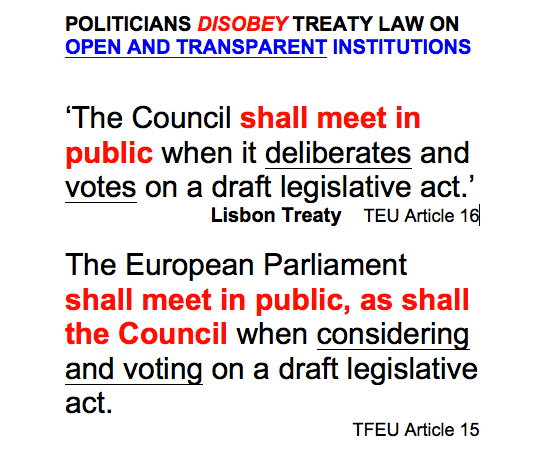
10 para 3. Every citizen shall have the right to participate in the democratic life of the Union. Decisions shall be taken as openly and as closely as possible to the citizen.
No more! From now on these politicians want the Commission to be exclusively controlled by the party cartel. They 'recommend' only party politicians can fill these posts -- for ever. Whoever asked them? The posts are open to all Citizens. That is the law. To act otherwise is outside the legal power of the politicians.

There is absolutely no article in the Treaties that says that the Commission posts are reserved for politicians. Nothing. Some articles are misinterpreted by politicians to try to say that politicians have powers to become Commissioners. A closer examination of these shows that in fact they say the opposite.

No politician is a super-citizen. The party cartel are therefore urgently seeking dishonest citizens or those who cannot read such articles and know nothing about the Community Method to pose their candidatures for the post of Commission President or Commissioners. The fallacies in the politicians' arguments and the illegality of their 'recommendation' will be examined in coming commentaries in this debate.  

21 February, 2013

Elysée2: Horsemeat fraud and de Gaulle's cuckoo

Do you have control to what politicians put in your mouth? Some 70,000 horses disappeared in Northern Ireland alone to the apparent consternation of authorities. They may have ended up in your lunch as Horse Lasagna.  What mischief happens in the UK, Romania, France, a dozen other countries and all the many labeling stations in-between has yet to be revealed.  Quantities of horse inflammatory medicine, bute, (phenylbutazone) have been detected. Bute can be harmful to humans. Other horsemeat forbidden for sale in America and thus exported to Canada is re-exported to Belgium and who knows where else in the Single Market. In this fantasy land across all of Europe from east to west, horse and pig and maybe chicken feathers and unspeakable additions, become ‘beef.

All this anti-democratic practice arose because of a simple fact. Europe lacks a democratic Community Agricultural Policy. It has never had one. Instead it has a policy still defined by anti-Community nationalist principles dating back to General de Gaulle in the 1960s. What we have today is in flagrant violation to the European Economic Community treaty. It is illegal. The treaties say that the consumer should be fully part of all agricultural decisions. Instead the consumer was cut out of decision-making – right from the beginning.

The European Commission now says that the public should be calm because all the meat constituents can be proved by its paperwork! The old-fashioned system where inspectors or meat workers could easily detect horse meat has been rendered null because frozen meat is directly mixed in vats. Previously any worker could distinguish the smell of horse from beef and they applied simple tests. Even test borings of frozen meat are no longer taken. Paper is king! Big mistake.

The Commission maintains all frauds could be detected and corrected by traceability certificates. Not true. Traceability investigations as food crosses five or six borders have been thrown into confusion when it was revealed that microchip animal identifiers can be bought on the internet for a few cents and veterinary documents are easily falsified with cheap stationery stamps.

The horsemeat fraud is a latest scandal in a whole cascade or historical pageant of multi-million euro rackets arising inside the EU agricultural system. At the core of the matter was de Gaulle's cuckoo egg. Under de Gaulle the whole of the Community system was distorted so that German industrialists were only allowed a single market for their products (many outclassing the French) if they subsidized French farmers (and Gaullist voters). This is far from the Community method where all States are equal and overall consumer interests are sought.

The total Community budget was soon bloated with agricultural spending taking the major part. This political fraud led to the Milk and Wine Lakes, where politicians milked the European taxpayer’s money for massive over-production to subsidize votes among the farming community. That was joined by the Meat Mountain scandal and the Butter Berg scandals (where further export subsidies provided cheap butter for the Soviet Union during the Cold War!). These rackets all had the same fingerprints  -- politicians committing fraud and abusing taxpayers as the helpless stooges.

Expect more scandals to come. The more agricultural products move from country to country before it reaches your mouth, the more you can expect that olive oil, orange juice and your shopping list of food and drink is adulterated by inferior and often dangerous mixtures.

Who is to blame? Who started it? Where the Founding Fathers of Europe responsible for this? Did they badly design the Common Agriculture Policy?

The answer is No. The first proposal for a supranational Agricultural Community, was presented by Pierre Pflimlin and Robert Schuman after widespread discussions in the Council of Europe, Europe’s great laboratory of ideas on integration. It aimed to bring in as much as possible the United Kingdom, and countries as geographically diverse as Greece and Turkey, Portugal, Switzerland, Norway and Turkey. For the UK and the Commonwealth and others the option of association was muted. Called after name of the French MRP politician the Charpentier Plan was passed by the Assembly of the Council of Europe. In the 30 November 1951 debate he said it was aimed ‘serving the best interests of farmers and consumers alike.’

Note it had nothing to do with gaining party political votes. It was aimed at balancing agricultural production and consumption with the help of a High Authority (or European Commission) thus removing surpluses or deficits and providing for public supported procedures for stocks, imports and exports by the fair means of the democratic assembly, an executive committee, a council of ministers and a court of justice.

These ideas met with British opposition and in France Communist and Gaullist hostility. A more restricted conception was implemented later in the Rome Treaties in 1957. The principles remained the same: a balance between farmers, farm workers and consumers on a pan-European scale.
The European Economic Community treaty  signed in Rome in 1957 has a whole chapter on the Agricultural Community. It provided for full democratic control of prices and supplies for the benefit of three categories:
  • farmers,
  • workers and
  • consumers.
They were never implemented!

By 1958 the Gaullists were in power in France. It was this generation that did not set up the Common Agricultural Policy (CAP) according to the treaties. This generation also distorted and manipulated the policy to feed their party political machines. The consumer suffered. The consumer paid.

The Treaties of Rome provide for safeguards to ensure low prices and high quality. If the Community organization had been implemented as described in the treaties there would never have been horse-meat frauds. There would never have been
  • Wine Lakes,
  • Milk Lakes,
  • Meat Mountains
  • Butter Bergs
  • Or subsidized sales of what Europeans saw as useless surpluses to the USSR,
  • The EU would not have dumped agricultural surpluses on developing countries;
  • nor would it have blocked developing countries from importing their foods into the EU allowing poor farmers there to gain a decent living from the land.
De Gaulle’s confidant and Minister of Information, Alain Peyrefitte later revealed how the de Gaulle saw the Community system as a political milch-cow and  sabotaged all democratic development.

De Gaulle rejected supranationality or European democracy as dangerous and totally opposed to his policy to dominate Europe.
‘That’s what we don’t want! That won’t do. That would be gross stupidity. Of the two treaties of Rome, I do not know which of them is the most dangerous! The Treaty on Euratom is worse that useless. — It is pernicious. I ask myself if we should not denounce it openly. And then there is the Common Market. It is a customs union, which can help us, provided that we realize a common agricultural policy, which is not instituted there, and several other common policies, which are not even mentioned,' he told Perefitte.

Did de Gaulle want a fully European Community Agriculture policy? Not at all. He wanted a French-centered agricultural policy, paid for by Europeans. He blocked any real Community policy. He had no motivation to treat other States as equals.

The treaty of Rome article 40 calls for something quite different from what de Gaulle delivered:
a. common rules for competition;
b. compulsory coordination of various national markets organizations;
c. a European Market Organization.

What was the purpose of this European Market Organisation? Article 39 spells out five objectives:
  1. increase in productivity
  2. ensure fair standard of living for agricultural workers;
  3. stabilize markets;
  4. assure availability of supplies
  5. ensure that supplies reach consumers at reasonable prices.
Note that consumers are a key part of the arrangement. Consumers are major co-decision-makers in the Treaties of Rome and of Paris. Yet politicians wrote out consumers of the agricultural arrangements, even though it is specifically written in treaty law.

For more than half a century the politicians have refused to put the consumer in a position to oppose their misappropriation of Community resources for voting purposes. That, in spite of the fact that the same articles about a European Market Organisation and other stipulations are repeated more or less word for word in the Lisbon Treaty!

This European Market Organization is at the center of all agricultural and food policy with the Economic and Social Committee giving overall guidance. The latter has never been properly elected as, again, de Gaulle blocked it as well as elections to the European Parliament.
The guiding Agricultural Market Organisation is to be composed of Producers, Workers and Consumers. In the 1960s there were many lobbyists rooting for farming interests. They even brought a cow into the Council of Ministers meeting! They rioted in the streets. They set off fire-crackers and waved flags and banners. Above all they threatened politicians with voting against them.

There were however no equivalent consumer organizations. So politicians ignored them. No consumers were asked about their opinions, nor did they activate the Economic and Social Committee to act on their behalf, because it was already hamstrung by politicians' refusal to treat it seriously as a sovereign body.

What was instituted was a perverse system – the mother and father of what is now called comitology.

Politicians created secret committees away from the press and public that would advise them on package deals. Diplomats were told to work out the best national deals to appease the agricultural lobbyists and let the European consumer go hang!

Instead of consumer rights being considered, the French strong-armed the others. They retaliated in similar measure. The French even threatened to withdraw from the Community in 1964 if they did not get their own way with Germany paying to support its cereal prices. (See the Common Agricultural Policy, Robert Akrill, p34).

The Commission proposed that the cereal and other prices should be subsidized from the Community budget via the TEMPORARY agency of the European Agricultural Guarantee and Guidance Fund, the FEOGA, Fonds Européen d’Orientation et de Garantie Agricole. Compared to how it was used, it is misnamed. It became a permanent subsidy, nothing to do with stabilized markets, competition, quality food and the benefit of consumers or in fact farmers. It became the cuckoo that soon took over TWO-THIRDS of the EU budget in 1988.

The ministers in Council, dominated by the French, surrounded themselves with their own closed-doors committees of their so-called experts. Absent was the main thrust of taxpayers – the consumers. Package deals were cut in secret and are still being made on the basis of power politics, not consumer interests of all European citizens.

Imagine what would have happened if the ministers and self-seeking politicians had followed the law of the treaties instead of distorting and blocking the treaty.

The consumers would have spoken out at the monstrous mountains and lakes frauds. Instead they had no voice. They would have not allowed their money to be wasted on such subsidies. Instead they would have pointed to the countries around the world that were far more efficient and provided top quality agriculture without subsidy.   Two effects would be apparent:
  • Stopping unnecessary waste, counterproductive subsidies,
  • Raising the efficiency of farms and productivity of farm workers to the benefit of consumers with lower prices and higher quality products.
The Franco-German governmental control of agricultural markets was shamelessly made apparent on the accession of the new Member States of Central and Eastern Europe. They were treated not as second class citizens but third class. They were refused equal treatment. There was no real rethinking of agricultural policy based on Community lines. Instead millions of farmers which had supplied food across eastern Europe and for other  markets were thrown out of work.

The consumer is left asking:
When are European leaders going to obey the treaties and bring in an empowered European Market Organisation to control and guide consumer interests for affordable, healthy and high-quality food?

22 January, 2013

Elysée1: Germans! French People! Are you still being fooled by de Gaulle?

Can you discern political propaganda and deceit? Do you know what real European democracy is? Today the French and Germans are spending a great deal of taxpayers’ money on celebrating 50 years of the January 1963  Elysée Treaty. They are being told it is the motor of Europe.

Rubbish!

It isn’t and never was. It was designed as a means to stifle European democracy by giving de Gaulle power over German resources. It was designed to control Germany, to mobilize the populations including the youth to support the Gaullist government and grant de Gaulle non-democratic powers. De Gaulle closed down all European democratic institutions. His plan was to destroy them if possible.

That is far from a Community approach. De Gaulle treated all the other Community States, Belgium, the Netherlands, Luxembourg and Italy as children. Above all he wanted to harness Germany and its economic power. He feared democracy especially European democracy or supranationality.

He told his Minister of Information Alain Peyrefitte:  ‘supranational integration is going to allow the Germans to teach the French organisation and discipline. All that is monstrous! Monstrous!

Is the Elysée Treaty the centre of European action? Did European reconciliation start with de Gaulle’s action? No. European reconciliation clearly started when Germany was allowed to enter the Council of Europe as a normal member and become an active member of the European Community in 1950.

Germany got equality from these institutions that Schuman and the Founding Fathers of Europe created. From the Elysée Treaty Germany gave its acquiescence to pay for Milk Lakes, Butter Bergs and Meat Mountains to support the French farmers’ votes for de Gaulle.

Was Adenauer fooled by the Elysée treaty subterfuge? No, he was not. But he went along with it because he needed de Gaulle’s support for his pro-western policy. De Gaulle had the key levers: the veto to make sure that any democratic State would not enter the European Community. Thus Norway, Denmark, UK and other countries were refused and Germany had to deal subserviently with France as the main power-broker. All democratic institutions of the Community such as the Parliament, the Consultative Committees were frozen or to use de Gaulle’s word ‘chloroformed’.

Did the Elysée Treaty bring Franco-German reconciliation? As Adenauer acknowledged, Franco-German reconciliation was accomplished more than decade before de Gaulle by Robert Schuman.

He wrote in September 1962:
Dear Mr Schuman,
During the visit of General de Gaulle last week, I often thought of you as the man who by his initiative of the Coal and Steel Community, laid the real foundations of the friendship which at present unites our two countries. It is with gratitude that I always think of our joint work. I would dearly like to express to you, especially in the present circumstances, my appreciation.  It would be a great joy for me if it were possible for us to meet again. Rochefort: Robert Schuman, p359.
Europeans – including both French and Germans should be highly suspicious when governments spend such money on political folderol and ignore historical facts – such as the sixtieth anniversary of the EU institutions. The real celebrations of reconciliation, European integration and democracy never took place last year.

Just ask the politicians who are busy spending French and German tax money:
Who was the first President of the European Community’s Council of Ministers?
Do they know? It was Konrad Adenauer who presided over the first Council of Ministers on 8 September 1952. France sat at the table while Adenauer, the German Chancellor, banged the gavel!
Adenauer had no need to celebrate reconciliation more than a decade later. The treaty only marks the fact that de Gaulle had to recognize the European Community as a fact that he could not destroy. It is a celebration hiding the change of policy of de Gaulle. It has nothing to do with real European reconciliation.

Before 1950 de Gaulle wanted to seize German territory such as the French occupation zone and the Saar, carve out the industrial Ruhr and draw new French borders on the Rhine. He denounced Bonn democracy and the Federal Republic of Germany as 'the Fourth Reich'.

That this Elysée Treaty celebration is political fraud on a large scale is clear from other facts of history. The Founding Fathers of the European Community also made this clear. Europe was to be based on solidarity of common objectives with the diversity of resources and the equality of States. Socialists and Christian Democrats in France and Germany opposed the treaty. The Community precludes a Gaullist-style Directoire or a secretive tête-à-tête or Franco-German axis.

This present exercise is a highly suspicious political Public Relations operation, especially given the almost total silence about the celebration of the SIXTIETH anniversary of the beginning of the Democratic institutions of the first European Community in 2012.

De Gaulle was also petty and vindictive. He forbade Adenauer from attending the funeral of Robert Schuman in Metz 1963. Adenauer had already agreed to come. Jean Monnet was also not invited to Metz. Six former prime ministers of France refused to attend in protest at the Gaullist action. Neither de Gaulle’s prime minister nor his minister of foreign affairs attended the funeral. RTF, the Gaullist controlled radio and television, hardly mentioned the event. (see Rochefort: Robert Schuman, p362.)

Is de Gaulle’s dictatorship, as François Mitterrand called it in 1964, the sort of event that real Europeans want to celebrate?

15 January, 2013

SECS3: Why your 2002 Euro is now worth 25 cents: the Commission

Europe’s political leaders have debauched your money. Imagine that in 2002 instead of exchanging your national currency into euros you bought gold. Today that gold would buy four times the number of euros. The same goes for oil. If you had bought silver, you'd have even more euros, wheat a bit less. Globally the euro is massively debased.

All along  history, politicians have debased currencies and spent more money than treasuries receive in taxes. Money is supposed to be a store of value. All pensions and investment require that what is saved should not be eaten away by government action. Politicians say they need inflation. That is theft from citizens. A globally-traded Community currency must be able to retain long-term, world value in spite of politicians.

A solid supranational currency cannot be constructed without a fully independent European Commission. The reason involves European ministers who were the first to legally debase the Euro currency. They even broke the inadequate rules in the Stability and Growth Pact. France and Germany then disobeyed European Court judgements. Yet they expect citizens to obey the Court.

The Commission brought this case before the Court. That is probably why the politicians make extra efforts to control it. They have now tried to turn the Commission into an exclusive club for politicians. Previously and according to all the treaties, no politician with a party card should hold the office of Commissioner.

Now politicians want a complete take-over of the Commission. Making it a joint secretariat for European parties would stop it embarrassing governments as lawbreakers in Court. Politicians have created their own complex rules to replace Court action. They want the freedom to debase the currency the way they choose, without Court judgements if possible.

Now composed almost entirely of card-carrying politicians, the Commission has tried to make its own internal rules to ‘permit’ political entryism. They are hardly valid. The treaties are the only legal touchstone that matters. The conduct of national politicians who parachuted their card-carrying friends into the Commission is self-condemnatory.

The citizens of Europe are perfectly able to see this misconduct for what it is. Flagrant violations seem not to deter politicians. Politicians seem addicted to party political nepotism. Normal citizens are despised as second class. The honest citizen scrupulously following treaty law who abandons compromising interests to become a Commission candidate is excluded by the political rascals who don’t.

What has happened is ILLEGAL. The Commission and its President are not reserved posts for party political fodder. It is not a political retirement home.

It is illegal for any politician under all treaties since 1951 including the politicians’ own treaty, that of Lisbon. At best only EX-politicians are allowed. The same applies to others:  EX-businesspeople, EX-trade-unionists, EX-professionals or EX-workers of any stripe. He or she has to resign previous functions.

Today we have three treaties governing the European Union. The Treaty on European Union, the Treaty on the Functioning of the European Union of Lisbon (these two replacing what was previously called the Customs Union, the European Economic Community or the Common Market) and the other treaty of Rome, Euratom, (also called European Atomic Energy Community treaty).

All of them state the same thing, that the Commission must be independent. No article of any treaty says that the Commission must be composed of politicians or national representatives of Member States.

They say the reverse. Anyone having membership of a political party must resign it. No one must take any instruction from a Member State government or any one else. TEU Article 17 says Commission members must be chosen on the ground of
their general competence and European commitment from persons whose independence is beyond doubt.
In any court of law it would be clear that if someone signs up to an ideological programme of a political party expressing different interests of lobby groups, then the Commissioner’s independence is more than in doubt. Any businessperson who on becoming Commissioner retained his business or other interests would also be guilty of double standards. Proof of guilt is furnished by party membership cards. The holders are not independent. Attendance at party meetings and participation in party organization is further condemnatory evidence.

The Lisbon treaty says that the Commission shall be chosen after parliamentary elections. Nowhere does it say that a politician involved in the elections should be made Commission President. Article 17 TEU rules it out. It specifies that the Commission must conform to its paragraph 3 and 5 restricting it to persons
whose independence is beyond doubt’ and who would ‘not take instructions from any government, or other institution, body, office or entity’. The person must ‘refrain from any action incompatible with their duties.’
That excludes an MEP or party leader whose ideological prejudices are amply proven by the parliamentary election. Nor should Commissioners be composed of national representatives. The Euratom Community commenced with FIVE Commissioners.

No professional activity other than Commissioner duty is allowed, whether paid or not. Lisbon’s Article 245 of the FEU reflects the supranational democracy of the 1951 Treaty of  Paris article 9. All other treaties have confirmed the independence criterion to this day.
Members of the Commission may not, during their term of office, engage in any other occupation, whether gainful or not.
Thus the Community system requires Commissioners to abstain from political parties or any other body whether ‘gainful or not.’

The first impartially chosen Commission was empowered to nominate some of its own members (article 10, Paris). All should have the impartiality of judges in Court and need to resign from bodies that might influence their judgement. Thus any citizen who has independence, experience, the public trust for seeking the European public good and honesty should be eligible.

Choosing Commissioners exclusively from those with party membership cards (2% of the population) is an offensive discriminatory act redolent of Nazism or Communism. It violates the human rights of 98 percent of citizens who are not party members. The majority of the European population refuses to vote in EP elections because of such flagrant abuse.

Sound European money and public confidence starts with the independence of its institutions.

09 January, 2013

SECS2: Citizens, demand your Euro rights! Top Citizens declare 2013 the Year of the Citizen!


Celebrate! Rejoice! This year 2013 is the Year of European citizens! Europe’s Politburo, its Top Citizens, has declared it to be so, without asking anyone. Did you agree to it or even know about its multimillion euro budget?

Yet hypocritically the politicians have not allowed citizens their rights for more than 60 years. Take the Euro as an example. It is a system devised by incompetent politicians (or ignorant of Community democracy), run by incompetent politicians to the advantage of politicians. Surely citizenship means more than European passports — that is changing the colour and size of national passports.

Europe’s citizens have still no means to control the politicians, nor how they raise taxes and spend them. Most citizens therefore refuse to vote. The citizens have no say in the extraordinary number of treaties, compacts, Stability Funds and Tax Haven companies cooked up by and for politicians in the margins of the Community and too often totally outside it and in flagrant contradiction with Community and democratic principles.

If anyone should consider the word ‘hypocritical’ too strong, remember the Year of the Citizen celebrates the twenty years of the Maastricht Treaty. That ‘EU’ system precipitated a major rejection of Community principles. Democracy.

In its 1992 referendum Denmark with a turnout of 83 % said No to Maastricht. Again the Top Citizens moved in and told them that this was not acceptable. The Danes were told to vote again in 1993. Robert Schuman himself warned about such political counterfeiters. These political counterfeiters are now involved in counterfeit currency. The Gaullists declared names of recipients of the CAP ‘top secret’. Now all currency deals are done in the dead of night behind closed doors. We have secret companies in Luxembourg, declaring themselves above the law.

The Politburo who decided to celebrate this year of citizens for Europe’s 500 million citizens also decided in 2012 that they would not celebrate the sixty years of the Community institutions, Commission, Council, Parliament.  The year 2012 was a NON Year. It took the Nobel Prize Committee to remind the Presidents of these institutions who eagerly took the prize in Oslo that 2012 should have been a major anniversary.

The European Founding Fathers set out the preconditions for a Community currency. This requires democratic legitimacy, not technocratic centralism. It should not be run by politicians. It requires a democratic means to root out political and statistical corruption.

Warnings were studiously ignored in the 1990s when the Euro was created.
Firstly, the political leaders — encouraged by de Gaulle’s ideas — have blocked the articles of the treaties and the Great Charter of 1951 (see http://www.schuman.info ). The Gaullist system ignored European citizens. Instead it made them pay for the Wine Lakes and the Meat Mountain scandals to buy farmer votes in France and elsewhere.

Secondly the post-Gaullist politicians decided to retain closed door Councils and the package deal system. It shut out all citizens from seeing or hearing about how European tax was being shared out among national politicians for their own pet projects. It rejected any elections to Community bodies — until the Court of Justice ruled they were acting illegally. The European parliamentary elections have NEVER been conducted according to Treaty specifications. The EP holds 27 national elections. They always favour of the national government politicians. That is a cheat.

Thirdly we now have the monetary equivalent of the Gaullist Wine Lake system. This time it is currency liquidity. The European Politburo is using THEIR Euro to paper over the cracks of the national currency abuses. This Euro was not originally designed for the corruptions of Greece, Spain and Portugal but for the corrupt practice in Italy, France and Germany.

The Gaullist Franco-German Axis powers were among the first to thumb their noses at the Growth and Stability Pact and ignore the judgements of the European Court of Justice when exposed.

How should a European Supranational Economic and Currency System be structured? The Founding Fathers insisted on democratic control for any currency — because it had to have:
  • the people’s support in its creation;
  • the democratic means to correct any systemic imperfections for countries, regions, businesses, workers and consumers, for tax systems and for migration policies;
  • the powers to innovate fully across the Community and to consider global responsibilities;
  • the powers to supervise what politicians might do;
  • the means to root out corrupt practice.
The Founding Fathers insisted that democratic institutions must be developed BEFORE the supranational currency was launched. These included a single Europe-wide election for the Parliament and elections for organized civil society in the three consultative committees.

For example the Economic and Social Committee should have elected representatives from European Business, Workers and Consumers associations. They should not be chosen from national groups at the whim of politicians for political favours back home. A really European Consultative Committee would supervise any plans for a currency. They would use their powers given them in the legislative process.

A properly elected Committee of Regions would supervise and actively be part of legislation about regional and national disparities and unemployment, as well as migrations issues. These bodies are still the play things of politicians, whether national or European. They are not independent bodies.

Instead the euro has been foisted on the public without the necessary democratic development repeated in all the treaties from that of Paris to Lisbon. Who created the euro? Politicians! But as any student of monetary economics knows the management of the money system should be run by an independent institution, supervised by another independent body, and should NEVER be put in the hands of politicians especially those who have shown themselves unable to balance their own budget or run the economy according to the rules.

16 December, 2012

Nobel3: EU Council's brazen Nobel Expo Fraud: General de Gaulle originated Europe's peace!!

At the December European Summit, the political leaders announced an exhibition with a brazen propaganda falsification about Peace in Europe. It contradicts what the Nobel Foundation said that the EU and its forerunners had brought ‘more than six decades of peace‘.

That apparently was a great shock for Europe’s leaders! On 10 December 2012 the Nobel Peace Prize  was awarded to  the EU and received in Oslo by Mr Herman van Rompuy of the European Council, Mr Barroso of the European Commission and Mr Schulz of the European Parliament.
All of them had simply ignored or rewritten their history. It was too dangerously democratic!
  • The European Commission did not celebrate the sixtieth anniversary of its first meeting on 10 August 2012.
  • On 11 September 2012 the European Parliament did not celebrate the sixtieth anniversary of its first assembly under the presidency of Paul-Henri Spaak. It did not get any mention even though the EP was in session in Strasbourg. Mr Barroso gave his State of the Union speech. He passed over that event in silence and that Spaak created a special assembly to form a European Political Community, exactly 60 years before. (It was sabotaged by Gaullists.) Mr Barroso announced the logically impossible goal of a Federation of Nation States. Meanwhile in the Paul-Henri Spaak building in Brussels, cracks in the ceiling of the parliamentary hemicycle put it out of action for more than a year.
  • The Council of Ministers did not celebrate the sixtieth anniversary of its first meeting on 8 September 2012.The Council initially met on 18 April 1951 at the signing of the Treaty of Paris and the Great Charter. Both required all future developments of this supranational Community to be based by the ‘free will of the people.’ De Gaulle buried this Charter. Who knows about it today?
The official website of the Council still falsely announces that the European Union began in 1958 — the date of the seizure of power of General de Gaulle. How is it that the Schuman Proposal was made on 9 May 1950 and brought about a democratic system with five independent institutions? How long will the Council try to out-Goebbels the Nazi propaganda chief by repeating lies?

Chairman of the Norwegian Nobel Committee Thorbjørn Jagland said peace in Europe was built by means of :
‘a binding commitment. It had to build on human rights, democracy, and enforceable principles of the rule of law. And on economic cooperation aimed at making the countries equal partners in the European marketplace. By these means the countries would be bound together so as to make new wars impossible. The Coal and Steel Community of 1951 marked the start of a process of reconciliation which has continued right to the present day.’ He was referring to supranational values like honesty, anti-corruption measures, openness, public debate about tax and budget and truth.
Released at the European Summit, the Council’s official brochure for the Nobel Peace Prize celebration is a gross perversion of history and truth. It distorts how Europe’s peace suddenly happened — when everyone expected continuous war for the future. The brochure announces the exhibition ‘The European Union working for peace‘ that opens on 18 December to 15 February.

Who made peace in Europe possible?
General Charles de Gaulle !!! His photo dominates the brochure. De Gaulle???
  • Yes , the same French autocratic General who wanted Spain’s autocrat Generalissimo Franco to join the Common Market and excluded democratic Norway, Ireland, Denmark and the UK! It also excluded Cyprus and Malta who had applied.
  • Yes, General de Gaulle who blackmailed by the ‘Empty Chair policy‘ the other Member States to accept a Common Agricultural Policy where European secretly subsidized French farmers above all. The Council shut its doors firmly closed to the taxpayers. It created the present unacceptable ‘package deals’ system of the Lisbon Treaty were the European citizen is milked without any democratic right to refuse.
  • Yes, de Gaulle who refused in 1959 the European Parliament’s demand (and Robert Schuman’s as its President) to end to the Parliament’s odyssey and have a single seat for Europe’s institutions in Brussels.
  • Yes, de Gaulle who hegemonicly tried to seize the levers of power through the 1961-2 Fouchet Plan. His French policy was to dominate all the other countries as the only A-Bomb power and UN Security Council member. Schuman wanted equality of Member States. (Paul-Henri Spaak denounced the plan, declaring that ‘Europe of tomorrow must be a supranational (democratic) Europe.’)
  • Yes, de Gaulle who after his outrageous attacks on Community Europe had a mass resignation of Europhile, democratic ministers in 1962. In reaction de Gaulle formed the Franco-German axis with the 1963 Treaty of Elysee, to the protest of the Europeans including Jean Monnet and Walter Hallstein and numerous other Franco-German deputies. They insisted on an anti-Gaullist preamble. Two months later on 29 March 1963 the European Parliament reaffirmed its attachment to ‘A supranational and democratic  Community based on the equality of rights of the Member States provided with its own institutions independent of the governments.’
Of all the leaders of Europe, the real Founding Fathers, the Council chose a photo of de Gaulle, who opposed the Founding Fathers like Poher, Rochefort, Mollet, Pleven, Monnet, Spaak, Bech, Luns, van Zeeland and so on. Adenauer opposed de Gaulle at first and all his anti-European and anti-Nato policies but eventually submitted to his wily politics because he wanted to tie BRD Germany to the West and avoid the reunification with the Soviet-dominated DDR. However de Gaulle wanted to create a DDR-style Gaullist Politburo in the Council of Ministers to dominate West Europe. We have it still today.

De Gaulle is shown shaking hands with Chancellor Konrad Adenauer in January 1963. No other names are mentioned. So the Great French Autocrat must be responsible for making ‘war not only unthinkable but materially impossible‘. Is the Council now openly declaring it is the Bastion of Gaullism? Who wrote this nonsense? Obviously not a 68-ter with a functioning memory who was involved in the anarchic riots in France that nearly brought the country to total impotence at de Gaulle’s autocratic, paternalistic ways. Paternalism or autocracy treats all other citizens as children. De Gaulle tried to bring the same anarchy to Europe so that he could divide and rule.

Supranational means that politicians should be honest and that the people should be free to choose as defined in Europe’s Founding Charter. Thanks to the Gaullists in the French Foreign Ministry this European Charter was buried and lost in the archives for sixty years.

Why is de Gaulle singled out in the Council’s extraordinary affront to history? Few people as much as Charles de Gaulle opposed the Community system that brought peace in Europe — the supranational Community system. Here’s what de Gaulle told Alain Peyrefitte, his confident and Minister of Information, about his secrets aimed at destroying the European Community.
In July 1960 — after the signature of the Treaties of Rome in 1957 — General de Gaulle told Peyrefitte:
‘Alfred Fabre Luce has just written that now that the French have shown the proof over the last two centuries that they have been incapable of governing themselves, supranational integration is going to allow the Germans to teach them organisation and discipline. All that is monstrous! Monstrous!’
When he conducted Peyrefitte to the door, General de Gaulle asked him to write a policy paper on the practical means to stifle supranationality. He explained that his policy so far to emphasize nationalism through the Pan-Europe movement (emphasizing a utopian Federation of Nations) was not succeeding. He needed greater means to activate and feed the major newspapers with more powerful anti-Community (that is anti-democratic) propaganda.
Peyrefritte  said: ‘It entails precisely creating situations where we can only get out of them by raising the dose of supranationality‘ (that is improving democracy at a European level).
De Gaulle replied: ‘That’s what we don’t want! That won’t do. That would be gross stupidity. Of the two treaties of Rome, I do not know which of them is the most dangerous! The Treaty on Euratom is worse that useless. — It is pernicious. I ask myself if we should not denounce it openly. And then there is the Common Market. It is a customs union, which can help us, provided that we realize a common agricultural policy, which is not instituted there, and several other common policies, which are not even mentioned.
Thus Europe got one of its great scandals of intergovernmental corruption: the Wine Lakes,  Meat Mountains, and the useless infrastructure projects  that were paid for by the European taxpayer to help de Gaulle garner in French voters to his party. No wonder the Greeks and others were so keen to join the same corrupt deals.
De Gaulle continued: ‘But the Common Market also includes (democratic) pretensions, that they call ‘supranational potentialities‘ (European democracy) which are not acceptable for us. ‘Supranationality that’s absurd! Nothing is above the nations, how then can nations decide together! The pretensions of the Commissioners of Brussels who want to give orders to the governments are ridiculous! Ridiculous!
De Gaulle thus showed himself to be a man of vision — a vision of returning to the nineteenth century of national conflict, the unstable ‘balance of power’ politics trying to crush opposing powers and resulting inevitably in bloody warfare. He wanted to put a stranglehold on Western Germany against what he called the Anglo-Saxons and the Soviet Union. He was willing to compromise European defence by kicking NATO headquarters out of France (that Schuman had arranged) and sabotaging the 1952 European Defence Community and the Council of Europe and its Human Rights system. For all these postwar achievements, Europeans owe a great deal to Robert Schuman.

Peyrefitte suggested that they make the supranational democracy inoperable in the two treaties of Rome but also attack the Treaty of Paris of the Coal and Steel Community — which had an even stronger dose of supranationality.

The Coal and Steel Community aimed at creating a strong, competitive energy and steel industry was eventually dropped after 50 years of service. Today we see Europe’s steel industry in catastrophic decline and the whole continent blackmailed by energy cartels with a vicious ulterior foreign policy motive. In those days oil was sold for around a dollar a barrel. Today it is priced at anything from 100 to 147 dollars!Today Europeans are calling again for Coal and Steel Community institutions to save industries from oblivion!

What a man of vision de Gaulle was!

Peyrefitte prepared a policy for de Gaulle about the practical means to stifle supranationality. His policies were pursued by de Gaulle including the Fouchet Plan to turn the European Commission into a Gaullist secretariat.

Unfortunately for de Gaulle and Peyrefitte, due to a clerical error, one of his texts was released to pro-European members of the Liberal faction in the European Parliament. A scandal broke out.
When Georges Pompidou presented his first Gaullist government to the French National Assembly he was met with stiff opposition. This is how Jean Legendre, deputy from Compiegne, hammered the policy to delight of all the deputies except the Gaullist UNR party. He said:
‘Mr Prime Minister we don’t know your ideas but we know those of Alain Peyrefitte who kindly sent us a note two years ago. In this he explained how the policy was to ‘deactivate the federal potentialities of the treaties of Rome‘ and to ‘chloroform Euratom‘. Well let me tell you, these ideas are exactly contrary to ours! We want to activate the federal potentialities of the treaty of Rome! We want supranationality! We want the United States of Europe! We will fight you if you try to damage it in any way!’
Peyrefitte said the UNR were in consternation as all the other benches gave this speech thunderous applause.

So it is with some public incredulity that the European Council and Council of Ministers dared to impose the history that illegitimately brought them massive corruption against the citizens of Europe. The financial crisis has brought Europe to the chasm of ruin today. The politicians need to learn supranational values like openness and honesty. The Council and the European Council should be open for all to see what goes on and the Commission should be composed of honest men and women who refuse to have any membership of political parties as the treaties insist. Instead, intoxicated still with Gaullist techniques over the years, the Council can not even discern the lies it has been spouting from the truth it has to present as real history.

For over six decades,’ says the brochure, ‘the European Union and its forerunners have contributed to the advancement of peace and reconciliation, democracy and human rights in Europe and beyond.’ Who and what were the forerunners? No idea!

According to the brochure, wars suddenly stopped because they kept recurring and World War II demonstrated the need for a new Europe’ !

Apparently all  it took was for General de Gaulle shake hands with Konrad Adenauer!
The Council has lost all credibility. This is an additional reason why the Nobel Prize should not have been awarded to an organization that denies its own history. They are as short-sighted as they are corrupters of facts and tax.

And where does the exhibition on peace take place? On a corner between the Council and the Commission buildings on the Robert Schuman Roundabout!!

06 December, 2012

Nobel2: Why the EU should not be awarded the Nobel Peace Prize

Was the Nobel Prize Foundation wrong to award the Nobel Peace Prize to the European Union? Yes. The prize should have gone long ago to the European Community and Robert Schuman. On 9 May 1950 he presented the idea and convinced the French government to initiate the Great Experiment in Peace. The EU has distorted the supranational democratic principles of the European Community that brought peace. It changed it into intergovernmentalism.

IF THE EUROPEAN COMMUNITY HAD NOT BEEN CREATED EUROPE WOULD HAVE BEEN BROKEN AGAIN BY AT LEAST ONE WAR, MAYBE TWO!!! The Community made war not only unthinkable but materially impossible. The US Marshall Plan that gave generous aid to Europe did not do that. Instead US diplomats worried when it was coming to an end that this reconstruction aid was helping start the industrialization that would bring another war. NATO the North Atlantic Treaty Organization was signed on 4 April 1949. Its key article was largely fashioned by Robert Schuman. Yet NATO did not bring peace to Europe. Schuman made that clear. After NATO was formed US|diplomats still foresaw war in Europe as inevitable.

Before the Schuman Proposal creating the European Community, the outlook for Europe was WAR.  Perpetual war every generation, not perpetual peace, was the near unanimous voice of the most experienced diplomats and think tank analysts. They foresaw that the European Continent would remain a battlefield for the future.

Economic reconstruction does not bring peace. The Marshall Plan  did not change the attitudes of hatred and the desire for revenge. It did not bring peace. It merely rebuilt national industries, many of them at the origin  of national economic rivalries. Tariffs were built up to prevent the entry of goods from neighbouring European countries. They preferred to trade with USA. These imports provoked a major shortage of dollars. The reconstructed industries merely provided the means for each country to build up their war industries. That is not surprising as it may seem today. European countries had been doing just that for centuries: recovering from war, waging war or preparing for next war.

Industrial power merely reinforced economic nationalism and divisive ideologies. EUROPEANS HAD GONE TO WAR EVERY GENERATION SINCE BEFORE THE TIME OF THE ROMANS.
The Americans in early 1950 admitted that they could do NOTHING to prevent Europe becoming a war zone again and again.

Look at this extract from the US-based Foreign Policy Association report on Europe and the United States. It was written and finalized March 1950 by Vera Micheles Dean, research director, FPA. She made an extensive tour of Europe speaking with government ministers and lecturing on US foreign policy around Europe.
We realize … that the United States, no matter how generously inclined, cannot under the most favorable political circumstances re-establish the economy of the continent on the foundations of 1914 or even of 1939. Some of these foundations, as already noted, have vanished beyond salvaging; others are perhaps not a total loss, such as the resources of colonies of southeast Asia, but their intrinsic value is greatly diminished, and their future contribution to the continent’s economy remains in doubt.
“No power on earth can remedy Europe’s impoverishment as a result of two world wars. The only remedy one can recommend for the future would be the avoidance of conflicts so costly in terms of human values and material wealth. Whatever we do, Europe will sooner or later have to adjust itself to a radically altered world economic situation and face the fact that the singularly favorable position it enjoyed during the five centuries following the discovery of the Indies and the of the New World and the conquest of the colonies in Asia and Africa is now drawing to a close. While the Russians and the Communists have capitalized on the predicament of western Europe, they did not bring it about.
She further observed that teenage Germans are ‘strongly imbued with Nazi ideas and, at best, apathetic towards democracy, which for them is associated with the rule of conquering western nations.’
The same conclusion was reached by the annual conference of US ambassadors in Europe in 1949. They considered European solutions as ‘pipe dreams’ and their ‘golden goose’ of the Marshall Plan was being sacrificed to various forms of nationalism. They were keenly aware of Soviet designs on Germany especially the industrial Ruhr.

This is the conclusion of General Lucius Clay, US Military Governor of Germany in March 1949.
“I repeat what I said in a cable a few days ago. We have lost Germany politically and therefore it really does not matter except that history will prove why there was World War III. No gesture can we make to draw Germany westward so why do we spend money on Germany. Thank God I will be out of it soon … “   (Papers of General Lucius Clay, vol 2, p1063.)
Emphasis added.

The Supranational Community, the centre of the 9 May 1950 Proposal of Robert Schuman changed the whole future of Europe. It created a new destiny. Today the EU has the largest GDP at 17.5 trillion dollars, equivalent to USA plus Canada plus India.
Today Europe is living in the LONGEST PERIOD OF PEACE in more than TWO THOUSAND YEARS.

The supranational system provides a means to turn States on the brink of war into a prosperous and thriving Community.
The present EU has abandoned much of the democratic principles of the Community. As proof can be cited the fact that nowhere else in the world have European leaders succeeded in creating a system that ‘makes war not only unthinkable but materially impossible‘ Do they know how it happened in Europe? Since the time of de Gaulle and his secret intergovernmental ‘package deals‘, Europeans have reneged on promises of European democracy. Instead they created a so-called ‘European Union’ that reduces the Community idea and places power in a closed-door European Council.
  • The EU has not even established Europe-wide parliamentary elections under a single statute that was required in the treaty sixty years ago!
  • It has not agreed to elections to the Consultative Committees like the Economic and Social Committee and the Committee of Regions. These are still the national playthings of the governments in Council, not European bodies. They should represent Europe-wide associations of enterprises, workers and consumers according to the original agreements with goverments.
  • The European Council makes its deals behind closed doors — just like the DDR writ large. The DDR, the German Democratic Republic was a psuedo-democracy, run as a puppet by the German Communist party and the Sovi8et Union.
  • The politicians of the EU have hidden for sixty years the great Charter of the Community that says the Community should be developed on supranational principles and that no decision should be made without the full-hearted agreement of the people.
  • Instead governments and eurocrats shamelessly ignore referendums that say the people do not agree with the fraudulent treaties such as the Constitutional and Lisbon treaties.
The awarding of the Nobel Peace Prize and the burgeoning financial crises of the intergovernmental method are a clarion call for all Europeans to reassess Plan D for Democracy.